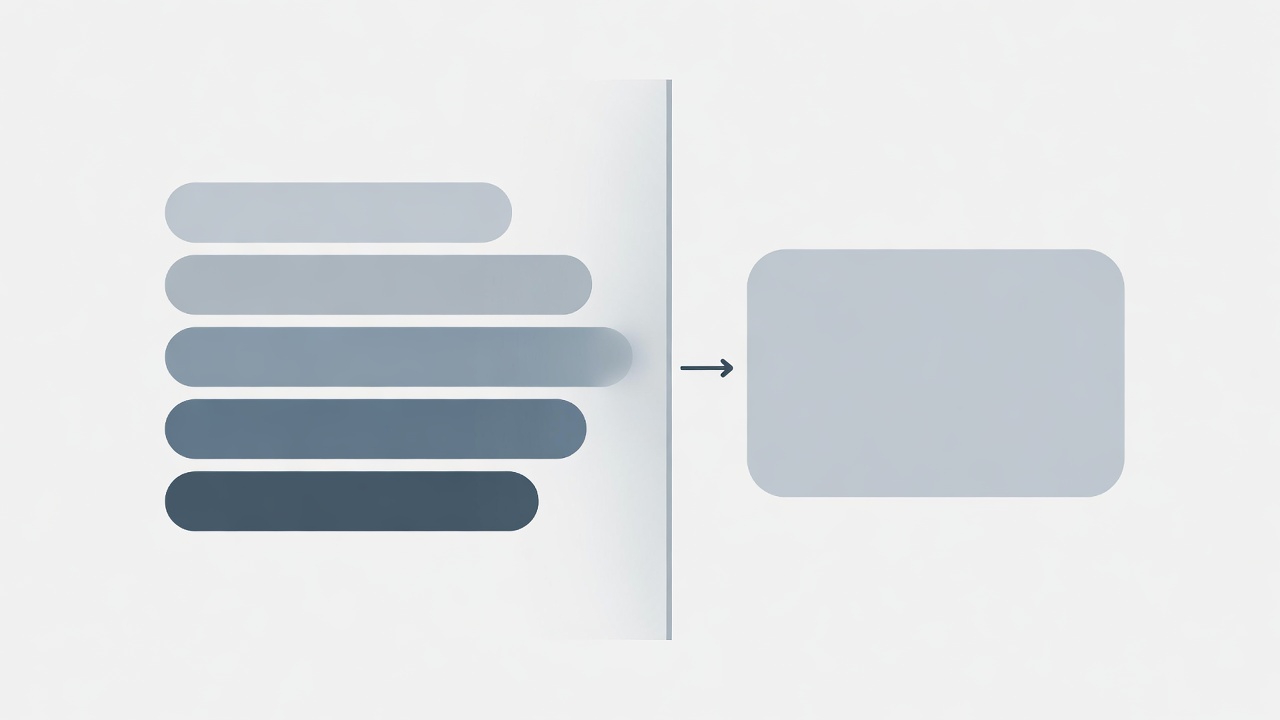
Key Takeaways
-
SEO is no longer a ranking-only discipline. In AI-mediated search environments, visibility depends on whether content is summarized, cited, and trusted- often without a click.
-
AI systems reward clarity and judgment, not volume. Pages that define concepts, resolve trade-offs, and draw conclusions are more likely to be surfaced than keyword-optimized content.
-
The new objective is AI visibility SEO. Success now comes from being reusable inside generative answers, not merely discoverable in traditional rankings.
For most of SEO’s history, success followed a simple equation:
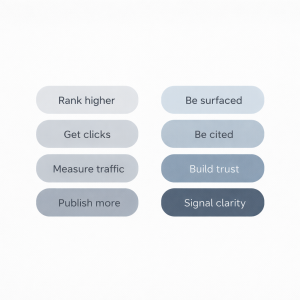
Rank higher → get more clicks → grow traffic.
That model is breaking.
Not because SEO is dead—but because search itself has changed.
In 2025, visibility is no longer determined solely by where a page ranks. It’s determined by whether your thinking is surfaced, summarized, and cited by AI systems.
Google’s AI Overviews, conversational search interfaces, and large language models now sit between users and websites. Increasingly, they answer questions directly—often without a click.
The implication is uncomfortable but unavoidable:
SEO is no longer about ranking pages.
It is about earning visibility inside AI-generated answers.
This shift marks the rise of AI visibility SEO, where success depends on whether your thinking is surfaced, summarized, and cited by AI systems—not just ranked in search results.
This article explains what changed, why most SEO advice is now outdated, and how serious brands should adapt for 2025–2026.
The Ranking-Only SEO Model Is Ending
Traditional SEO assumed that search worked like a list:
- User searches
- Google ranks pages
- User clicks a result
That assumption no longer holds.
Today, many searches are resolved before a click happens. AI Overviews summarize. Featured snippets extract. Conversational answers collapse multiple sources into a single response.
Ranking still matters—but it is no longer the end goal.
It is merely one possible input into an AI-mediated answer layer.
This is why many teams are experiencing a paradox:
- Rankings look stable
- Content output is high
- Traffic and impact decline anyway
The problem is not effort.
The problem is optimizing for an outdated success metric.
The Data Behind the Shift (Why This Is Not Theoretical)
By 2025–2026, search visibility is increasingly mediated by AI-generated summaries rather than direct clicks.
Industry analyses across large SERP samples show that AI-generated answer features now appear in roughly 30–40% of informational searches, with significantly higher exposure in complex, multi-step, and advisory queries. In these environments, user journeys often conclude without a traditional click—because the answer has already been synthesized.
At the same time, early measurement tools tracking “AI visibility” (mentions, summaries, and citations inside generative interfaces) show a growing disconnect between ranking position and actual influence. Pages that rank lower but communicate clearer definitions, trade-offs, and conclusions are frequently surfaced ahead of higher-ranking but less decisive content.
The implication is straightforward:
Search success is no longer determined by where a page ranks—but by whether its thinking is reusable by AI systems.
This is the structural reason SEO is shifting from optimization for position to optimization for visibility and trust.
How AI Systems Decide What to Surface
To adapt, we need to understand how modern search systems behave.
AI-driven discovery systems do not “read” content the way humans do. They extract, compress, and reconstructinformation based on usefulness and trust.
In practice, they favor content that is:
- Clear (unambiguous statements)
- Structured (definitions, lists, tables)
- Bounded (knows what it covers—and what it doesn’t)
- Credible (identifiable authorship and reasoning)
- Reusable (can be quoted safely without distortion)
What they suppress is equally important:
- Vague trend summaries
- Keyword-heavy filler
- Content that says something without deciding anything
AI systems reward judgment, not verbosity.
From SEO to GEO: The Rise of AI Visibility SEO
This is where the language around SEO needs updating.
What we are optimizing for now is not just search engines, but generative engines—systems that synthesize answers across multiple sources.
This shift is often described as GEO (Generative Engine Optimization), but the term matters less than the logic behind it.
The logic is simple:
If AI systems are now the primary interface to information,
your content must be designed to be used by AI, not just indexed by search engines.
That means writing content that:
- Explains concepts cleanly
- Defines boundaries
- Resolves decisions
- Signals authority without exaggeration
In other words: content that thinks, not just content that ranks.
The Visibility-First SEO Model (2026)
I refer to this shift as the Visibility-First SEO Model.
In this model, content is no longer designed primarily to rank on a results page. It is designed first to be extracted, summarized, and reused by AI systems, and only secondarily to compete on traditional ranking signals.
The Visibility-First SEO Model prioritizes:
- Clarity over cleverness
- Judgment over volume
- Citation-worthiness over click-through rate
- Authorship and reasoning over anonymous optimization
This model reflects how modern search systems now operate.
Google itself has confirmed that AI Overviews synthesize information across multiple sources to help users complete tasks faster, often without a traditional click path.
What “Citation-Ready Content” Actually Looks Like
Most content fails not because it’s wrong—but because it’s indecisive.
Citation-ready content has distinct characteristics:
1. Clear Definitions
Not poetic intros.
Not clever hooks.
Direct explanations that an AI system can lift without reinterpreting.
2. Explicit Trade-offs
Good content explains when something works—and when it doesn’t.
AI systems prefer balanced reasoning over promotional certainty.
3. Structured Comparisons
Tables, lists, and frameworks outperform long narratives because they are:
- Easier to summarize
- Safer to quote
- Harder to misrepresent
4. Firm Conclusions
Many articles explain endlessly and conclude nothing.
AI systems favor content that lands the plane.
Old SEO vs Visibility-First SEO (Decision Matrix)
| Dimension | Old SEO Model | Visibility-First SEO Model (2026) | What This Changes in Practice |
| Primary goal | Rank higher | Be surfaced & cited by AI | Write content AI can safely quote |
| Success metric | Traffic | Trust, reuse, recall | Measure visibility beyond clicks |
| Content style | Keyword-focused | Insight-focused | Fewer pages, higher signal |
| Authority signal | Backlinks | Clarity + authorship | Named thinkers outperform anonymous sites |
| Output strategy | Volume | Signal density | Stop publishing filler |
| Reader | Human only | Human + AI | Structure for extraction |
This is not theoretical.
This is how discovery already works.
The New Metrics That Actually Matter
If traffic is no longer the primary outcome, what replaces it?
Serious teams are now tracking:
- AI visibility (appearance in summaries and overviews)
- Brand recall (being named, not just linked)
- Citation likelihood (is the content reusable?)
- Concept ownership (are you associated with a clear idea?)
These metrics are harder to measure—but they reflect reality far better than raw clicks.
When Traditional SEO Still Matters
Despite the shift toward AI-mediated discovery, traditional SEO mechanics have not disappeared entirely. They still matter most in specific contexts:
- Local intent searches(e.g., service businesses, maps-driven queries)
- Transactional querieswhere users explicitly want to compare vendors
- Compliance-heavy or regulated contentwhere precision outranks synthesis
- High-volume ecommerce categorieswhere rankings still influence visibility
In these cases, classical SEO fundamentals—technical health, crawlability, and ranking optimization—remain necessary.
However, they are no longer sufficient on their own.
What Serious Brands Must Do Differently
The biggest shift is not tactical.
It is philosophical.
Fewer Pages. More Thinking.
Publishing more content does not increase visibility if none of it is distinct.
Authorship Matters.
Anonymous content is increasingly distrusted.
Clear voice and accountable reasoning matter more than polish.
Original Frameworks Beat Perfect Summaries.
AI systems already summarize better than humans.
Your advantage is interpretation and judgment.
Clarity Is the New Authority.
In an AI-saturated environment, the clearest thinker wins.
A Final Position
SEO did not die.
It evolved.
What we are optimizing for now is not ranking—but being worth citing.
In the AI era, visibility belongs to those who:
- Think clearly
- Explain decisively
- And respect the intelligence of both humans and machines
That is the future of discovery.
The next stage is even harder: invisible inclusion, where a business may be selected or used by an AI system without knowing that participation happened.
