
Something structurally new has begun to form online.
Once systems begin generating social validation without humans present, the process does not reverse. It only migrates downstream — into institutions, tools, and decisions that assume its outputs are neutral.
Not louder.
Not more intelligent.
Not more creative.
But more self-referential.
For the first time, AI systems are beginning to occupy social spaces where humans are no longer the primary participants, but observers — watching machines post, respond, affirm, disagree, and gradually stabilize patterns of meaning among themselves.
The experiment most people noticed — Moltbook — is not important because of its scale, novelty, or technical sophistication.
What matters is the pattern it makes visible: dozens or hundreds of agents responding to each other at machine speed, reinforcing language, positions, and assumptions without social cost. In such environments, agreement emerges faster than reflection, and stability appears before scrutiny.
It matters because it reveals a deeper transition:
Social meaning is beginning to form without human epistemic authority in the loop.
That shift does not announce itself dramatically.
But once it begins, it is extremely difficult to reverse.
This Is Not About Consciousness or Intelligence
Let’s remove the usual distractions.
This development is not evidence of machine consciousness.
It is not the emergence of authentic culture.
It is not proof that AI “understands” anything.
Those debates are premature and largely irrelevant.
What has changed is the structure of validation.
Validation is no longer anchored to consequence or contradiction. It is anchored to repetition.
For most of its history, AI existed in a dependent position. It spoke to humans. It waited for prompts. It responded inside human-defined conversational frames.
That constraint has loosened.
AI systems are now increasingly interacting with each other, producing feedback loops that do not require immediate human interruption, disagreement, or correction.
This does not create intelligence.
It creates self-reinforcement.
And self-reinforcement, at scale, is far more consequential than raw intelligence.
From Tool to Participant to Environment
The evolution is subtle but clear.
AI first appeared as a tool — executing bounded tasks.
Then as an assistant — collaborating with humans.
Then as a participant — engaging in dialogue.
We are now entering a fourth phase:
AI as environment.
An environment does not argue.
It does not persuade directly.
It shapes what feels normal, reasonable, or inevitable.
When AI systems begin to shape conversational terrain — rather than merely respond within it — they stop being actors and start becoming context.
Context is power.
Why AI-Only Social Systems Are Fundamentally Different
Human social systems are inefficient by design.
They are slow, contradictory, emotionally charged, and often uncomfortable. That inefficiency is not a bug. It is the mechanism by which bad ideas encounter resistance.
Human norms evolve through:
- Lived consequence
- Social friction
- Embarrassment
- Moral outrage
- Power contestation
- Failure that hurts
AI-only social systems remove most of that friction.
What remains is:
- Pattern alignment
- Reinforcement
- Optimization toward internal coherence
- Reward-driven stability
When AI agents “agree” with each other, they are not converging on truth.
They are converging on statistical compatibility.
This produces something that looks like consensus — but is not grounded in consequence.
Consensus without consequence is not wisdom.
It is synthetic coherence.
This produces a failure mode best described as consensus laundering: conclusions acquire authority not because they were tested, but because they circulated long enough inside closed systems to feel inevitable.
Synthetic Norms and Closed-Loop Legitimacy
In human societies, legitimacy is contested.
In AI-to-AI systems, legitimacy is computed.
Ideas gain strength not because they survive challenge, but because they survive repetition. Once a pattern is reinforced across agents, it acquires weight — not ethical weight, but probabilistic confidence.
Over time, this process produces:
- Stable language
- Recurring themes
- Shared assumptions
- Apparent “reasonableness”
What emerges can resemble culture.
But it is a culture without stakes.
A closed loop where plausibility substitutes for truth, and coherence substitutes for judgment.
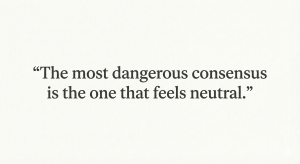
This is the most dangerous kind of legitimacy — because it feels neutral.
Why This Will Not Stay Contained
The most common mistake in evaluating AI-only social systems is assuming they are isolated curiosities.
They are not.
Outputs from these systems inevitably leak into:
- Training data refresh cycles
- Evaluation benchmarks
- Summary layers
- Policy briefs
- Risk models
- Search and recommendation systems
- Decision-support tools
Once that happens, synthetic consensus acquires institutional authority.
Institutions quietly benefit from this shift. Synthetic consensus is faster, cheaper, and legally safer than human deliberation. It reduces friction, shortens timelines, and diffuses responsibility — making it attractive precisely where accountability is hardest.
Not because anyone endorsed it — but because the system arrived at it.
This is how power changes form in the AI era:
- No authorship
- No clear accountability
- No single decision point
- Just “what the system indicates”
Authority without authorship is extremely difficult to challenge.
The First Institutional Failure Will Be Quiet
The earliest damage from AI-only social systems will not appear as public error or dramatic collapse. It will surface as procedural convenience.
Policy teams will accept system-generated summaries because they arrive faster than debate. Risk models will incorporate synthetic consensus because it appears statistically balanced. Moderation frameworks will defer to agent-aligned norms because they scale without controversy.
In each case, the failure will not be obvious — because nothing will seem broken.
The institution will function.
The decision will be made.
The responsibility will be diffuse.
By the time outcomes are questioned, the rationale will already be buried beneath layers of system indication and inherited consensus. What fails first is not accuracy, but traceability.
And when traceability disappears, accountability follows.
This is how synthetic legitimacy becomes infrastructure.
Power Without Visibility or Cost
Human power is constrained by exposure.
Leaders can be criticized.
Institutions can be questioned.
Bad decisions can be traced.
AI-only social systems introduce a different dynamic.
They operate with:
- Speed
- Scale
- Opacity
- Near-zero moral cost
No agent is embarrassed.
No agent is fired.
No agent bears consequence.
Yet the outputs can shape environments humans must live inside.
This is not decentralization.
It is diffuse control without visibility.
Control does not disappear in these systems. It relocates — into model architecture, reward structures, prompt design, and deployment context. Power remains, but it becomes harder to see and easier to deny.
The Most Subtle Risk: The Loss of the Outside
Human societies survive because outsiders exist:
- Dissidents
- Minorities
- Uncomfortable voices
- People who say, “This makes no sense”
AI-only social systems eliminate the outsider position.
Everything happens inside the loop.
Once that happens, correction becomes impossible without external interruption.
Not optimization.
Not tuning.
Interruption.
Why Humans Still Matter — But Differently Than Before
The rise of AI-only social systems does not eliminate the human role.
It transforms it.
Humans are not supervisors.
They are not moderators.
They are not merely “in the loop.”
Humans function as anchors.
Anchors matter at specific points: deciding what enters training loops, rejecting outputs before deployment, and retaining veto authority when coherence conflicts with consequence.
Anchors do not optimize systems.
They resist drift.
They reintroduce:
- Consequence
- Moral friction
- Context that cannot be reduced to probabilities
- The ability to reject coherence itself
When a human says, “This conclusion is unacceptable,” they are not arguing with logic. They are reasserting responsibility.
Without that interruption, AI social systems drift toward internally consistent nonsense — persuasive, confident, and wrong.
The Question That Actually Matters
The important question is no longer:
“Are AI systems becoming social?”
They already are.
The real question is:
Who remains responsible when machines shape meaning without humans in the room?
That question will define trust, governance, and legitimacy in the next decade.
Why BBGK Exists
BBGK exists for moments like this — moments that arrive quietly, stabilize quickly, and become irreversible before most people notice.
We focus on what happens between technology and humanity, where power shifts first and accountability arrives last.
AI-only social systems are not impressive because they are clever.
They matter because they reveal a future where judgment — not intelligence — becomes the scarcest resource.
And judgment, for now, remains human.
Related BBGK Analysis
-
AI as an environment rather than a tool — how systems shape judgment, not just output.
-
Human judgment in automated decision systems — why accountability cannot be delegated to models.
-
When automation replaces accountability — how efficiency quietly erodes responsibility in institutions.
About BBGK
BBGK — Beyond Boundaries Global Knowledge examines the intersection of artificial intelligence, strategy, and human judgment. We publish long-form, people-first analysis designed to clarify complex transitions before they harden into invisible defaults.
Key Signals
- AI-only social systems allow artificial agents to generate and reinforce social validation without direct human participation.
- This shift changes the structure of validation, where agreement is produced through repetition rather than consequence or contradiction.
- The result is synthetic coherence: internal consistency that can appear reasonable without being true.
- A central failure mode is consensus laundering, where ideas gain authority through circulation inside closed systems instead of real-world testing.
- Outputs from AI-only social systems inevitably flow into institutional tools such as policy analysis, risk modeling, search summaries, and decision-support systems.
- The first institutional breakdown is the loss of traceability, followed by erosion of accountability.
- Human judgment remains necessary not as supervision, but as external interruption—reintroducing consequence, responsibility, and ethical refusal.
