The AI leadership readiness stack is a practical framework for senior leaders who need to govern artificial intelligence before it spreads across the organization faster than accountability, risk controls, data discipline, and human judgment can keep up.
Most organizations are no longer asking whether AI matters. That stage is over. Employees are already using AI tools. Vendors are adding AI features into familiar platforms. Teams are testing copilots. Leaders are asking for productivity gains. Boards are hearing about AI risk. Customers are beginning to encounter AI-shaped experiences, even when they are not told that AI is involved.
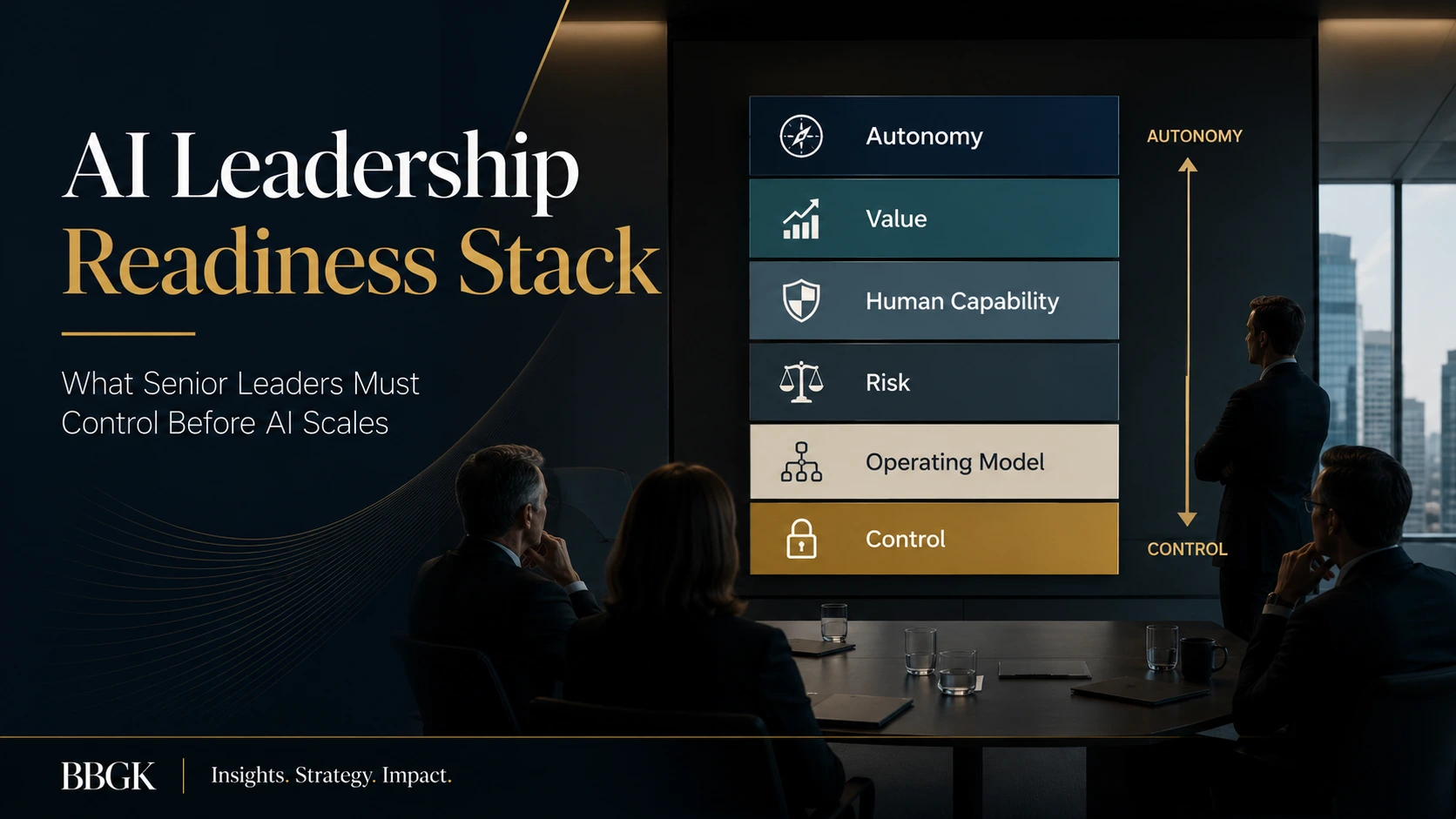
The harder question is different: what must senior leaders control before AI is allowed to scale?
That question matters because AI does not enter an organization as a single tool. It enters through writing, search, analysis, customer support, reporting, hiring, compliance, sales, software, operations, finance, cybersecurity, and decision support. It changes workflows. It changes what people verify. It changes what employees delegate. It changes what managers can measure. It changes where mistakes can hide.
A company can adopt AI quickly and still be unready for AI.
That gap is the reason BBGK created the AI Leadership Readiness Stack: a framework for understanding the six layers senior leaders must align before AI becomes a normal part of organizational work. This article connects with BBGK’s earlier work on why weak governance creates the AI trust crisis, the AI Decision Boundary Framework, AI cognitive dependency, and the limit of AI without domain expertise.
Key Takeaways
- AI readiness is not the same as AI adoption. Adoption means people are using tools. Readiness means the organization can govern, measure, secure, and explain AI use.
- Senior leaders need a control model before they need more pilots. AI governance, risk, ROI, data readiness, workforce redesign, and human oversight are connected layers, not separate projects.
- The biggest AI risks are often organizational. Shadow AI, tool sprawl, unclear ownership, weak procurement, poor data discipline, and unmanaged automation can create more damage than the model itself.
- AI ROI depends on workflow redesign. Value rarely comes from adding AI on top of broken processes. It comes from changing how work, decisions, evidence, and accountability flow.
- Agentic AI raises the leadership bar. When AI systems can plan, trigger actions, use tools, or interact with systems, leaders need stronger approval paths, logging, access limits, monitoring, and shutdown authority.
What Is the AI Leadership Readiness Stack?
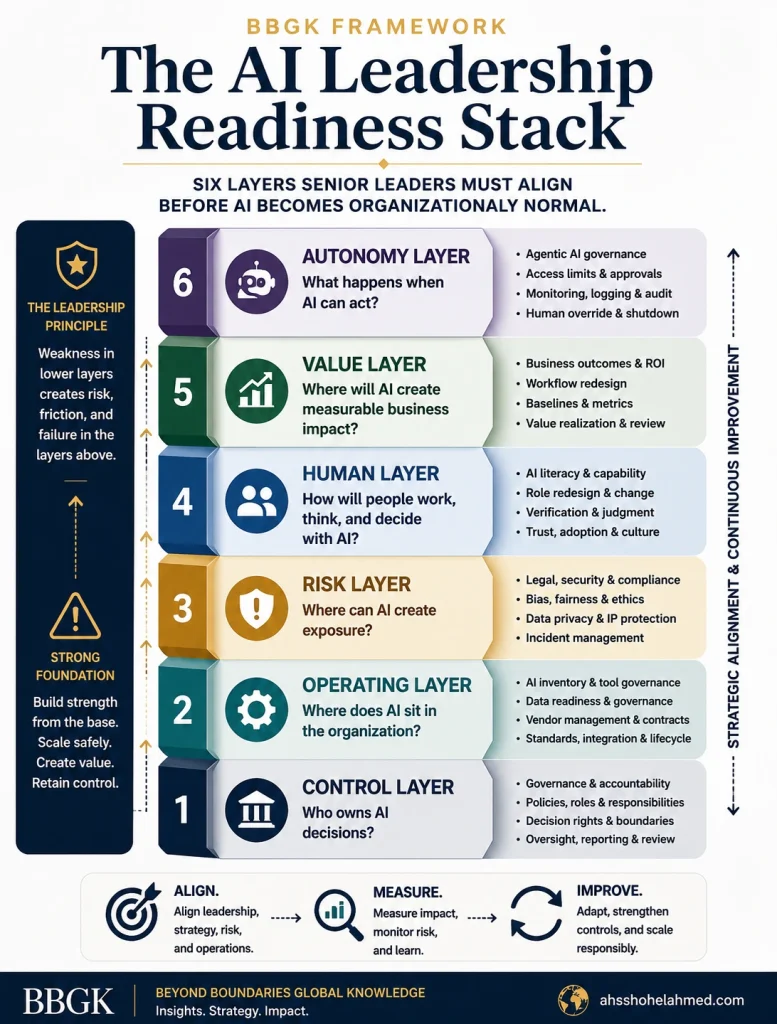
The AI Leadership Readiness Stack is a BBGK framework that organizes AI readiness into six leadership layers: control, operating model, risk, human capability, value, and autonomy.
It is designed for senior leaders, board members, executives, transformation teams, risk leaders, and strategy owners. It does not begin with prompt engineering or tool selection. It begins with institutional responsibility.
That distinction matters. Many AI conversations start in the wrong place. They begin with questions like: Which AI tool should we use? Which platform is best? How do we train employees? How do we get faster output? How do we prove ROI?
These are useful questions, but they are not first-order leadership questions. The first-order questions are deeper:
- Who owns AI-related decisions?
- Where can AI create risk?
- Which workflows should AI change?
- Which decisions should AI never close by itself?
- How will employees verify AI outputs?
- How will the organization know whether AI improved anything?
- What happens when an AI system takes action, not just produces content?
The AI leadership readiness stack gives leaders a way to answer those questions in sequence.
Why Senior Leaders Need a Stack, Not a Checklist
AI checklists are useful, but they have a weakness: they make every item look equally important.
AI governance, regulation, cybersecurity, AI ROI, operating model, tool sprawl, data readiness, board literacy, workforce redesign, human oversight, responsible AI, and agentic AI are all important. But they are not equal. Some are foundations. Some are controls. Some are symptoms. Some are consequences.
A checklist asks: Have we considered this? A stack asks: What must be true before the next layer can safely work? That is the better leadership question.
For example, AI ROI depends on data readiness, workflow redesign, adoption quality, and decision ownership. Responsible AI depends on governance, transparency, escalation, and human oversight. Agentic AI depends on cybersecurity, access control, procurement standards, audit trails, and approval logic. Workforce redesign depends on AI literacy, trust, manager capability, and a clear understanding of which tasks should be automated, assisted, or owned directly.
AI readiness is not one capability. It is a layered operating discipline.
The BBGK Framework: Six Layers of AI Leadership Readiness
The layers are ordered as a stack: each one is a precondition for the layers above it. The AI leadership readiness stack gives senior leaders a practical way to see where governance, operations, risk, people, value, and autonomy depend on each other. Read from the base up. Weakness low in the stack does not stay contained. It propagates upward, quietly degrading every layer built on top of it. The order is therefore not a ranking of importance but a sequence of dependency.
- Control Layer: Who owns AI decisions?
- Operating Layer: Where does AI sit in the organization?
- Risk Layer: Where can AI create exposure?
- Human Layer: How will people work, think, and decide with AI?
- Value Layer: Where will AI create measurable business impact?
- Autonomy Layer: What happens when AI can act?
Each layer answers a different leadership question. Together, they define whether an organization can scale AI without losing control, trust, or judgment.
AI Leadership Readiness Stack: Summary Table
| Layer | Leadership Question | Common Failure | Control Needed |
|---|---|---|---|
| Control Layer | Who owns AI decisions? | Vague accountability | Governance, ownership, escalation rules |
| Operating Layer | Where does AI sit in the organization? | Tool sprawl and shadow AI | Inventory, procurement, standards |
| Risk Layer | Where can AI create exposure? | Unmapped security, legal, ethical, or trust risk | Risk classification, monitoring, review |
| Human Layer | How will people work and decide with AI? | Overtrust, resistance, weak verification | AI literacy, role design, change management |
| Value Layer | Where will AI produce measurable impact? | Pilots without ROI | Baselines, metrics, workflow redesign |
| Autonomy Layer | What happens when AI can act? | Uncontrolled agency | Access limits, approval paths, logging, shutdown controls |
Layer 1: The Control Layer: Who Owns AI Decisions?
The control layer is the base of the stack. Before an organization scales AI, it needs to know who owns AI-related decisions, risks, policies, exceptions, incidents, and consequences. Because every layer above depends on a named owner, weakness here does not stay contained: it leaves risk unowned, value unowned, and autonomy unowned.
This sounds simple until something goes wrong. If an AI-generated recommendation leads to a flawed customer decision, who owns the outcome? The employee who accepted the recommendation? The department that deployed the tool? IT? Legal? The vendor? The executive sponsor? The board?
If the answer is unclear, the organization does not yet have AI governance. It has AI activity.
Effective AI governance should define:
- Which AI use cases are allowed, controlled, restricted, or prohibited
- Who approves AI tools and workflows
- Who owns AI-related risk inside each business function
- Which decisions require human review
- What must be documented before AI outputs are used
- How incidents, errors, disputes, and complaints are escalated
- How leadership reviews AI performance and risk over time
The point is not to slow innovation. The point is to prevent responsibility from becoming vague at the exact moment technology becomes more powerful.
This is why the NIST AI Risk Management Framework is an important reference point. NIST frames AI risk management around governance, mapping, measurement, and management. It gives organizations a way to think about trustworthy AI as a system, not as a slogan. ISO/IEC 42001 is also relevant because it treats AI management as an organizational system. That matters for senior leaders because AI governance is not only about model behavior. It is about policies, responsibilities, records, risk treatment, continual improvement, and management accountability.
Control Layer Leadership Test
Can we name the person, team, or body responsible for every AI-influenced decision that matters? If not, AI should not scale further until ownership is clarified.
Layer 2: The Operating Layer: Where Does AI Sit in the Organization?
The operating layer sits directly above control because it is the substrate the rest of the stack rests on. Until AI is visible and its data is sound, the layers above run on guesswork: risk cannot be mapped, value cannot be measured, and autonomy cannot be governed.
In many organizations, AI sits everywhere and nowhere at the same time. IT controls some tools. Legal reviews some risks. Business units run their own pilots. Marketing uses generative AI for content. Sales uses AI for outreach. HR tests AI in recruitment or training. Employees use consumer AI tools because they are faster than approved systems.
This creates tool sprawl, duplicate subscriptions, weak oversight, unclear standards, unmanaged vendor risk, and shadow AI.
The operating layer should clarify:
- Who approves AI tools
- Who maintains the AI inventory
- Who monitors AI use and risk
- Who owns vendor due diligence
- Who reviews AI-specific contract clauses
- Who controls access to sensitive data
- Who decides when an AI pilot becomes part of normal operations
This is also where AI procurement becomes more important. An organization may not build its own model, but it still becomes responsible for the systems it buys, configures, integrates, and allows employees to use. A vendor’s AI feature can change data exposure, employee behavior, customer experience, and decision quality. That means procurement cannot treat AI as a normal software checkbox.
AI-specific procurement should examine:
- Data retention and training policies
- Security controls
- Audit logs and admin visibility
- Human oversight features
- Model update policies
- Vendor transparency
- Regulatory alignment
- Exit, portability, and dependency risk
In this framework, data readiness belongs inside the operating layer because AI cannot be governed, measured, or trusted when the underlying data is fragmented, outdated, inaccessible, or poorly owned.
The operating model does not need to be heavy. But it must be explicit.
Operating Layer Leadership Test
Do we have one visible operating model for AI, or many hidden ones? If AI ownership is fragmented, risk will be fragmented too.
Layer 3: The Risk Layer: Where Can AI Create Exposure?
The risk layer identifies where AI can create legal, operational, cybersecurity, reputational, financial, or ethical exposure. It depends on the two layers beneath it: you cannot map risk you do not own (control) or cannot see (operating). And unmanaged exposure here can erase value above it and makes autonomy dangerous to grant.
This is broader than traditional cybersecurity. AI introduces familiar risks in unfamiliar forms. Examples include:
- Sensitive data entered into public or poorly governed AI tools
- AI-generated content that includes false, unsupported, or misleading claims
- Unreviewed automation in customer communication
- Biased or unfair decision support in hiring, lending, education, insurance, care, or eligibility
- Prompt injection and insecure output handling in AI-enabled applications
- Deepfake, impersonation, and synthetic media risk
- Employees relying on AI outputs because they sound fluent and confident
The risk layer is where many organizations discover that their existing controls were built for older systems. Traditional software usually behaves within a narrower range of predictable logic. AI systems can produce fluent errors, respond differently across contexts, handle ambiguous language, and interact with messy human instructions. That does not make AI unusable. It makes AI governance necessary.
The OWASP Top 10 for Large Language Model Applications is useful here because it gives security teams and business leaders a clearer language for AI-specific risks such as prompt injection, sensitive information disclosure, insecure output handling, and excessive agency. The EU AI Act also reinforces a risk-based approach to AI. Even for organizations outside the European Union, its structure signals where regulation is moving: higher-risk AI systems require stronger responsibility, transparency, documentation, and oversight.
Risk Layer Leadership Test
Do we know where AI can affect rights, access, money, safety, privacy, reputation, or trust? Those areas require stronger review than low-stakes productivity use.
Layer 4: The Human Layer: How Will People Work, Think, and Decide With AI?
The human layer is often reduced to training. That is too narrow. It sits high in the stack for a reason: weak capability here quietly undermines the layers above it. Value becomes noise, and autonomy loses its most important safeguard: informed human oversight.
AI literacy matters, but the deeper issue is human adaptation. AI changes how people search, write, summarize, analyze, decide, communicate, and evaluate. It also changes what they may stop practicing.
This is why BBGK has argued that AI should be studied not only as a productivity tool, but as a force that reshapes memory, attention, questioning, judgment, and meaning. The issue is not only whether employees can use AI. The issue is whether they can still think well with AI present.
The human layer includes:
- AI literacy for non-technical teams
- Manager capability in AI-enabled workflows
- Employee trust and resistance
- Role redesign
- Human judgment standards
- Verification habits
- Board and executive literacy
- Change management
Weak AI literacy creates two opposite failures. Some employees overtrust AI because it sounds confident: a risk explored in BBGK’s work on when AI gives bad advice. Others reject AI because they do not understand where it is useful. Both responses are expensive.
The goal is not to make every employee an AI engineer. The goal is to help people understand when AI is useful, when it is risky, when it needs verification, and when human judgment must remain primary. This connects with BBGK’s analysis of knowledge distance and domain expertise. AI can extend capability, especially in structured or adjacent work. But when a task depends on deep context, institutional memory, ethical judgment, lived experience, or high-stakes consequence, tool fluency is not enough.
Human Layer Leadership Test
Are we training people to use AI faster, or to work with AI more intelligently? The second question is the real leadership task.
Layer 5: The Value Layer: Where Will AI Create Measurable Business Impact?
The value layer separates AI activity from AI progress. It sits near the top of the stack because real value depends on everything beneath it: ownership, a sound operating model, managed risk, and a capable workforce. Without that foundation, scaling AI, including granting it autonomy, has no business justification to stand on.
Many organizations mistake usage for value. More AI tools, more pilots, more prompts, more internal demos, and more excitement do not automatically create business impact. AI ROI usually appears when three things happen together:
- A real business problem is selected
- The workflow is redesigned around that problem
- The result is measured in business terms
Without that discipline, AI becomes performance theater. People use it. Leaders mention it. Slides look modern. But the business does not materially improve.
Senior leaders should define AI value through practical questions: Which revenue, cost, speed, quality, risk, or customer experience metric should improve? What is the baseline before AI is introduced? What workflow will change? Which human decisions will AI assist, accelerate, or replace? What evidence will prove that AI improved the outcome? What would count as failure?
This is where AI leadership readiness becomes commercial. Governance without value becomes bureaucracy. Value without governance becomes risk. Leadership must hold both together.
A practical example: if a customer service team uses AI to summarize calls, the value is not “we used AI.” The value may be faster resolution time, better follow-up accuracy, lower repeat contacts, more consistent documentation, or improved manager coaching. If those outcomes are not measured, the company may only have a faster process for producing noise.
Value Layer Leadership Test
Can we connect each AI initiative to a measurable business outcome, not just a productivity story? If the answer is no, the organization may be running pilots without a value architecture.
Layer 6: The Autonomy Layer: What Happens When AI Can Act?
The autonomy layer is where AI leadership readiness becomes urgent, and it is the top of the stack because it can only ever be as sound as everything beneath it. An organization that grants AI the ability to act while the lower layers are weak multiplies every weakness underneath.
Many early generative AI use cases were output-based: write a draft, summarize a document, generate ideas, analyze text, create a report. These uses still require governance, but they are easier to contain.
Agentic AI changes the problem. When AI systems can plan tasks, call tools, access databases, trigger workflows, send messages, update records, or make recommendations that lead directly to action, the organization is no longer governing content alone. It is governing behavior.
This raises harder questions: What actions can the AI system take without approval? What data can it access? What tools can it use? What decisions require human confirmation? How are AI actions logged? How can the system be stopped? Who reviews failures? What happens when an AI agent follows instructions correctly but produces a harmful result?
Agentic AI should not be governed with a simple yes-or-no model. The better approach is proportional control. A read-only assistant that helps an employee search internal documentation does not need the same controls as an agent that can send customer messages, change CRM records, approve refunds, alter financial data, or trigger operational workflows.
For senior leaders, the core issue is not whether AI agents are impressive. The core issue is whether the organization has enough visibility and authority to interrupt them.
Autonomy Layer Leadership Test
Do we have clear approval, monitoring, logging, and shutdown paths for AI systems that can act? If not, agentic AI should remain limited to controlled environments.
Where AI Readiness Usually Breaks
AI readiness usually breaks in predictable places. The problem is not always technical weakness. More often, it is a mismatch between technological speed and organizational discipline.
Leadership Treats AI as a Tool Instead of a System
A tool can be bought. A system has to be governed. AI affects people, processes, vendors, data, customers, and decision rights. If leaders treat it as another software category, they miss the operating redesign required to make it useful and safe.
Governance Arrives After Adoption
Many companies wait until AI use is widespread before creating rules. By then, habits are already formed, tools are already embedded, and employees may have normalized risky behavior. Governance should not arrive as punishment after adoption. It should be designed as the condition that allows adoption to scale.
ROI Is Measured Too Late
If success metrics are not defined before an AI pilot begins, the organization may end up inventing a success story after the fact. Every serious AI initiative should begin with a baseline, a measurable target, and a clear view of what will change in the workflow.
Data Readiness Is Assumed
AI does not magically fix poor data. In many cases, it exposes poor data faster. If an organization has fragmented systems, outdated records, inconsistent definitions, weak metadata, unclear ownership, and poor access controls, AI will inherit those problems.
Human Oversight Is Too Vague
The phrase “human in the loop” is often too weak. Which human? At what stage? With what authority? Using what evidence? Under what escalation rule? Human oversight only works when it is designed into the workflow. A tired employee clicking “approve” at the end of an automated process is not meaningful oversight.
The First AI Readiness Audit Senior Leaders Should Run
Senior leaders do not need to solve every AI issue at once. They do need to create a clear starting point. The first audit should answer five questions.
What AI Tools Are Already Being Used?
Start with an AI inventory. Include approved enterprise tools, vendor features, browser extensions, workflow automations, embedded AI inside existing platforms, and informal tools employees may be using. The goal is not to punish employees. The goal is visibility. Leaders cannot govern what they cannot see.
Which Use Cases Carry Real Risk?
Classify AI use cases by risk. Low-risk drafting support is not the same as AI-assisted hiring, lending, diagnosis, eligibility, legal review, financial analysis, customer commitments, or compliance work. The organization should know which use cases are allowed, controlled, restricted, or non-delegable.
Who Owns Each AI Use Case?
Every meaningful AI use case should have an accountable owner. Not a vague function. A real owner. Ownership should include performance, risk, documentation, escalation, vendor management, and periodic review.
What Business Outcome Should Improve?
AI initiatives should be tied to measurable outcomes. If the goal is speed, define speed. If the goal is quality, define quality. If the goal is cost reduction, define the cost baseline. If the goal is better decisions, define what better means. Without a measurable outcome, the organization may only be measuring enthusiasm.
Where Must Human Judgment Remain Primary?
Some decisions should not be handed over to AI. Others can be assisted by AI but must remain human-owned. Leaders should define these boundaries before employees are forced to improvise them under pressure. BBGK’s AI Decision Boundary Framework is the tool for this: it separates decisions AI can Automate, decisions AI can Assist, and decisions humans must Own Directly.
Applying the AI Decision Boundary Framework: Automate, Assist, Own Directly
A practical AI leadership model should not invent a new vocabulary for deciding what AI may do. BBGK’s AI Decision Boundary Framework already provides the canonical distinction: decisions AI can Automate, decisions AI can Assist, and decisions humans must Own Directly. At the organizational level, those three categories become use permissions: one model, applied from individual decisions up to enterprise policy.
Automate
Automate covers low-risk tasks where AI can improve speed or convenience without touching sensitive data, high-stakes decisions, regulated activity, or external commitments. The AI can close the loop with minimal friction. Examples may include internal brainstorming, summarizing non-sensitive materials, drafting first versions of internal documents, organizing notes, or improving writing clarity.
Assist
Assist covers tasks where AI supports the work but a human makes and owns the decision. These involve customer communication, sensitive information, financial impact, legal exposure, HR processes, regulated work, brand risk, or operational decisions. They require review, documentation, clear ownership, and defined escalation. AI accelerates the work; the human remains accountable for the outcome.
Own Directly
Own Directly covers decisions the organization should not allow AI to make or finalize because the outcome affects rights, opportunity, dignity, safety, livelihood, consent, or meaningful access. In these areas, AI may support analysis, but the institution must retain direct human responsibility for the decision itself.
What a Mature AI Operating Model Looks Like
A mature AI operating model does not need to be large. It needs to be clear. At minimum, senior leaders should establish:
- An AI ownership group with representation from strategy, technology, legal, security, risk, operations, and relevant business units
- An AI inventory that tracks approved tools, active pilots, embedded AI features, vendors, use cases, and data exposure
- A risk classification process that separates low-risk, controlled, restricted, and non-delegable use cases
- A procurement standard for reviewing AI vendors, data use, contractual risk, model behavior, auditability, and exit options
- A measurement model that ties AI initiatives to business outcomes
- A workforce enablement plan that teaches verification, limits, judgment, and responsible use
- A review rhythm for incidents, policy updates, performance, adoption, risk, and value
This is not bureaucracy. It is the basic infrastructure of responsible scale.
Why AI Readiness Is Now a Board-Level Issue
AI is becoming a board-level issue because it affects strategy, risk, compliance, reputation, workforce capability, and long-term competitiveness. Boards do not need to manage AI tools directly. But they do need to ask better questions:
- Do we know where AI is already being used?
- Do we have named executive ownership for AI risk and value?
- Are high-risk AI use cases classified and governed?
- Are we measuring business impact or only adoption?
- Do we understand our exposure through vendors and embedded AI?
- Are employees trained to verify AI outputs?
- Do we have rules for agentic AI and AI systems that can take action?
These questions are not technical details. They are governance questions. Senior leaders who avoid them may still move fast, but they may be moving without a steering system.
Direct Answer: What Should Senior Leaders Control Before Scaling AI?
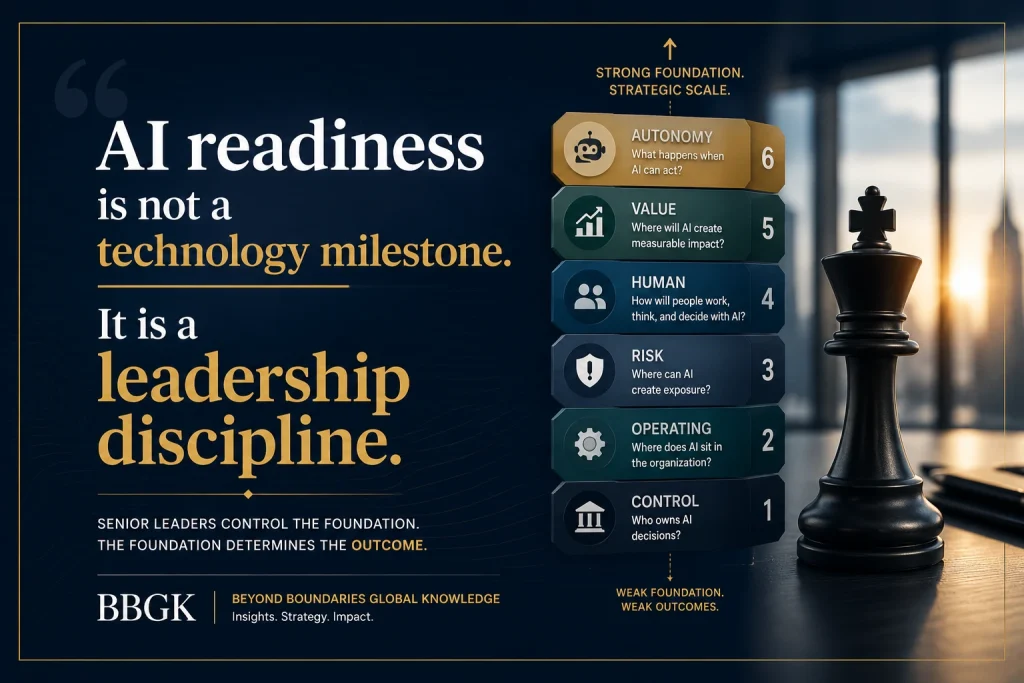
Senior leaders should control six areas before scaling AI: governance and accountability; operating model and procurement; risk and compliance; workforce readiness; measurable business value; and autonomy controls for AI systems that can act.
These areas should be managed as a stack, not as separate checklists, because weakness low in the stack propagates upward. Weak governance leaves every layer unowned. A poor operating model: invisible tools, weak data: makes risk unmappable and ROI illusory. Unmanaged risk erases value. Weak workforce capability turns AI output into confident noise and removes the main safeguard on autonomy. And uncontrolled autonomy multiplies every weakness beneath it. AI readiness is not a technology milestone. It is a leadership discipline.
Practical AI Leadership Readiness Checklist
Governance
- Do we have a clear AI policy that employees actually understand?
- Is there named ownership for AI risk and AI value?
- Do we know which AI tools are currently being used?
- Do we classify AI use cases by risk?
Data and Security
- What sensitive data is prohibited from AI tools?
- Are AI vendors reviewed before adoption?
- Do we know how vendors store, process, retain, and use our data?
- Do we have controls for prompt injection, data leakage, insecure outputs, and excessive agency?
Business Value
- Which AI initiatives are tied to measurable outcomes?
- Do we know the baseline before implementation?
- Are workflows being redesigned, or are tools being added on top of old processes?
- Do leaders review AI impact after deployment?
People and Work
- Are employees trained on when not to trust AI?
- Do managers know how AI changes role design?
- Are teams expected to verify important AI outputs?
- Do employees know when human judgment must override automation?
Agentic AI
- Can any AI system take action without human approval?
- What systems, tools, and data can AI agents access?
- Are AI actions logged and reviewable?
- Can humans pause, reverse, or escalate automated actions?
Selected Standards and Reference Points
This article uses the following standards and reference points as external anchors:
- NIST AI Risk Management Framework: a widely used framework for managing AI risks to individuals, organizations, and society.
- ISO/IEC 42001: an international AI management system standard for organizations that develop, provide, or use AI systems.
- EU AI Act: a risk-based legal framework for artificial intelligence in the European Union.
- OWASP Top 10 for Large Language Model Applications: a security reference for major risks in LLM-enabled applications.
FAQ: AI Leadership Readiness
What is AI leadership readiness?
AI leadership readiness is the ability of senior leaders to govern, measure, secure, and control AI use across an organization. It includes accountability, risk management, data readiness, ROI discipline, workforce capability, procurement standards, and human oversight.
What is the AI Leadership Readiness Stack?
The AI Leadership Readiness Stack is a BBGK framework that organizes AI readiness into six layers: control, operating model, risk, human capability, value, and autonomy. It helps leaders understand what must be governed before AI scales across the organization.
Why do senior leaders need AI governance?
Senior leaders need AI governance because AI can affect decisions, workflows, data exposure, customer communication, employee behavior, compliance, reputation, and trust. Without governance, AI adoption can spread faster than accountability.
What is the difference between AI adoption and AI readiness?
AI adoption means people or teams are using AI tools. AI readiness means the organization has the governance, data, skills, workflows, controls, and measurement discipline required to use AI responsibly and effectively.
What is shadow AI?
Shadow AI refers to employees or teams using AI tools without formal approval, security review, IT oversight, or governance. It can create risks related to data leakage, compliance, cost, duplication, and accountability.
What is agentic AI governance?
Agentic AI governance is the set of controls used when AI systems can plan, use tools, trigger workflows, or take actions. It requires access limits, approval rules, audit logs, monitoring, escalation paths, and human shutdown authority.
How should companies start improving AI readiness?
Companies should begin by creating an AI inventory, classifying use cases by risk, assigning ownership, defining approved and restricted uses, setting ROI metrics, and training employees on verification and human judgment.
Final Thought
AI will keep getting easier to use. That is not the problem. The problem is that ease can hide complexity. A tool that feels simple at the user level may create deep questions at the organizational level: who owns the decision, where the data goes, what the system changes, what humans stop checking, and who carries the consequence.
The senior leadership task is not to chase every AI possibility. It is to decide what AI may do, what humans must still own, and what the organization must never leave undefined.
That is the real meaning of AI leadership readiness. The AI leadership readiness stack exists to make that boundary visible before ambition outruns judgment.
BBGK – Beyond Boundaries Global Knowledge. Insights. Strategy. Impact.
