What prayer reveals about movement, attention, time, and the architecture of human regulation. Beyond theology, growing interest in the health benefits of Salat has opened a wider conversation about movement, attention, mental calm, and the structure of daily life.
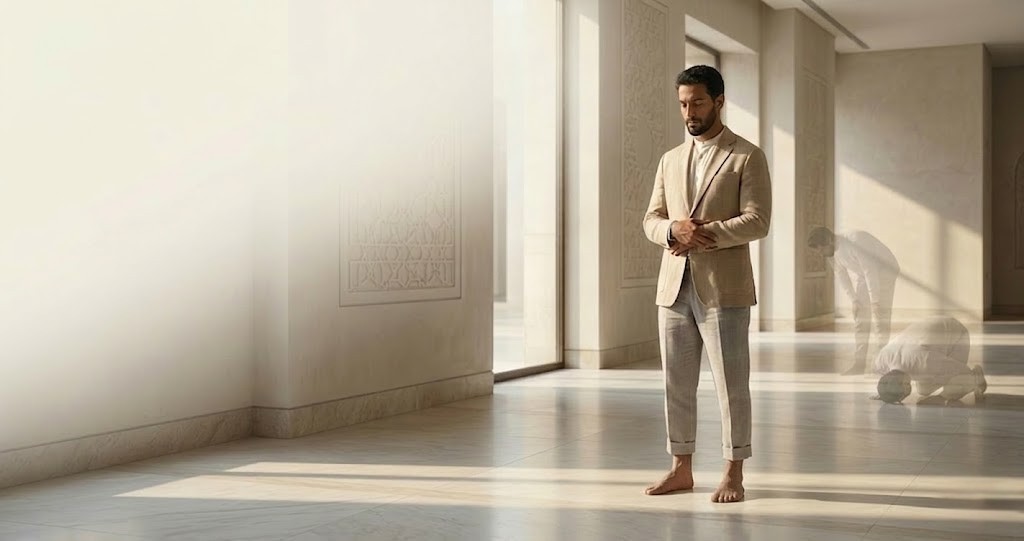
The Health Benefits of Salat: Body, Mind, and Daily Structure
There are practices in human civilization that endure not only because they are believed, but because they are lived—repeated, embodied, and carried across generations not as theories, but as rhythms.
Note: This article draws on available research and review literature on the health-related dimensions of Salat. It is not written to provoke religious debate, but to encourage reflection, harmony, and a broader human understanding of the practice.
Salat is one of those practices.
For believers, it is first and rightly an act of worship: submission, remembrance, and alignment before God. That meaning should not be reduced to physiology. Yet another question remains worth asking, especially in an age shaped by stress, fragmentation, and relentless self-optimization: beyond theology, what kind of human system is embedded within this ritual?
Key Insights
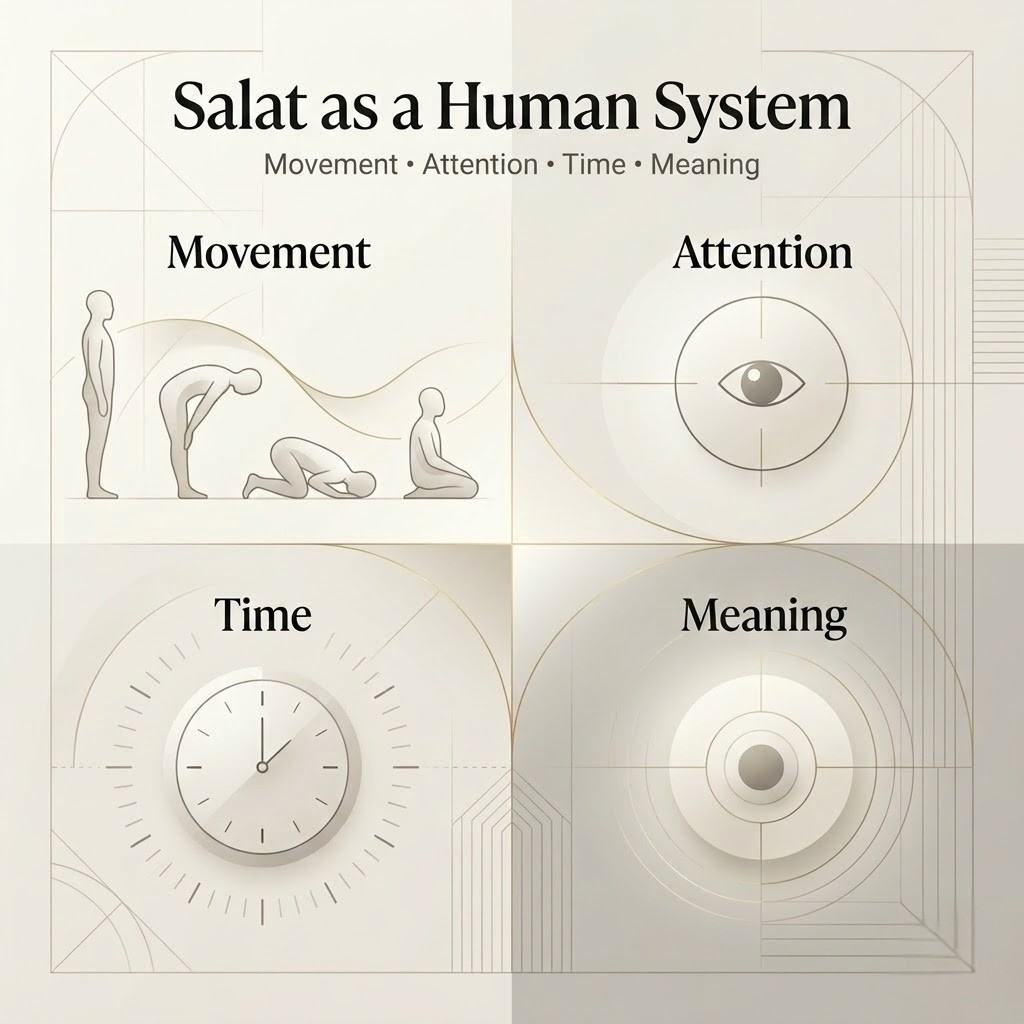
- Salat can be viewed not only as a spiritual practice, but also as a structured human system involving movement, attention, time, and meaning.
- The strongest research support relates to light physical activity, mobility, and short-term stress modulation—not exaggerated neurological claims.
- Its deeper relevance today may lie in how it interrupts sedentary living, mental drift, and the loss of meaningful pauses.
The question matters because modern life has produced a particular kind of exhaustion. We move less, think more, react constantly, and rest poorly. The body is underused, the mind overstimulated, and the day often unfolds as one long, unbroken stream of demand. In response, modern culture offers separate remedies: exercise for the body, meditation for the mind, productivity systems for time, therapy for emotional overload, breathwork for stress.
Salat does something structurally different.
It does not isolate movement from attention, or attention from time. It integrates them. Not occasionally, not when motivation appears, but repeatedly across the day within a disciplined inherited form. That is what makes it intellectually interesting. Not because it is exotic, but because it may contain, in lived and repeated form, a quiet architecture of human regulation.
The strongest scientific reading of Salat is not that it is a miracle technology, nor that it replaces medicine, nor that every attractive health claim made in its name is true. The strongest reading is more disciplined: Salat can be understood as a distributed daily system that combines light physical movement, attentional reset, and temporal structure in ways that produce measurable physical and psychological effects. The best-supported evidence points to its role in low-intensity physical activity, mobility maintenance, and acute stress modulation; broader claims about long-term neurological transformation and disease prevention remain far less certain.[1][2]
The Modern Problem: Disintegration
One of the quiet tragedies of contemporary life is not simply that we are busy. It is that our systems no longer speak to one another. The body sits while the mind races. The calendar fills while attention scatters. Our days are measured, but not fully inhabited. We know more about productivity than rhythm, more about stimulation than balance.
In such a world, the value of a disciplined practice lies not only in what it does in a moment, but in the pattern it imposes over time.
Salat imposes a pattern.
It asks the body to move, the mind to return, and the day to pause—briefly, but deliberately—around something other than urgency.
From a human-systems perspective, Salat can be understood as an architecture of interruption. It interrupts sedentary continuity. It interrupts mental drift. It interrupts the assumption that a person should pass through the entire day in one unbroken psychological state.
It does not remove stress from life. It interrupts its continuity.
Movement Without the Culture of Exercise
Modern health thinking often recognizes only two states: exercise and inactivity. Physiology is less binary than that. Much of long-term health maintenance lives in the middle ground—mobility, circulation, postural variation, low-intensity movement, and the breaking of prolonged stillness.
This is where Salat becomes physically meaningful.
Its repeated sequence of standing, bowing, prostrating, sitting, and rising again creates cyclical movement across multiple joints, repeatedly altering body position and disrupting static posture.[2][3] Current analysis supports the view that the physical execution of Salat falls within light-to-moderate activity, often described in the range of roughly 2.0 to 3.5 METs, with associated value for mobility, circulation, and anti-sedentary interruption.[1][2]
This should not be overstated. Salat is not a substitute for strength training. It does not build endurance in the way sustained walking, running, or sport can. It should not be marketed as a complete fitness system.
But dismissing it because it is not intense would be equally shallow.
Human health is preserved not only by intensity, but also by frequency, joint use, postural variation, and the repeated refusal of stillness when stillness turns into stagnation. The body often declines not through one dramatic failure, but through small neglected losses accumulated over years: less mobility, more stiffness, poorer balance, longer periods of sitting.
Salat modestly but persistently pushes against that drift.
Its transitions recruit the lower limbs, load the posterior chain, and move the body through flexion, release, and range shifts that prevent it from living in one rigid shape all day. Even when the metabolic demand is light, the structural demand is real. This is why the most credible public-health reading of Salat is not “prayer as exercise” in a simplistic sense, but prayer as built-in movement maintenance.[1][2][3]
In a sedentary civilization, that is meaningful.
Much of the current discussion around the health benefits of Salat is strongest when it focuses on mobility, stress modulation, and structured pause rather than exaggerated scientific claims.
A Nervous System Repeatedly Invited to Reset
Movement alone, however, is not the whole story. What distinguishes Salat from many ordinary movement routines is that it combines posture with pacing, recitation, breathing rhythm, and attentional narrowing. This gives it another layer of importance: the regulation of arousal.
Many people now live too close to the edge of sympathetic activation. Not always in the form of visible panic, but as chronic readiness—alertness without ease, reactivity without recovery, thought without settling. The body is rarely in crisis, but rarely fully off duty either.
Here the evidence becomes moderate rather than definitive. Existing research suggests that prayer practice can induce acute parasympathetic shifts, reflected in heart-rate variability changes and brainwave patterns associated with relaxation and focused calm.[4][5] The most defensible interpretation is not that Salat uniquely rewires the nervous system in ways no other practice can, but that it appears to function as a repeatable stress-modulating routine whose pattern of movement and attention the nervous system recognizes as regulatory.[1][4]
That distinction matters.
Some of the calming effect may arise from spiritual meaning. Some from expectation. Some from the physical sequence. Some from breathing and rhythm. The current evidence does not isolate these perfectly, and serious analysis should not pretend otherwise. Some EEG findings also suggest that portions of the calming response may be linked to patterned movement and attentional structure rather than theology alone.[4][5]
Many people now live too close to the edge of sympathetic activation. Not always in the form of visible panic, but as chronic readiness—alertness without ease, reactivity without recovery, thought without settling. The body is rarely in crisis, but rarely fully off duty either. This condition is intensified by the wider AI cognitive impacts shaping modern attention, memory, and mental rhythm.
But this does not weaken the significance of the practice. It clarifies it.
Human beings are not divided creatures. Rhythm matters. Posture matters. Repetition matters. Breath matters. Meaning matters. When these converge, the nervous system often responds.
Attention in an Age of Cognitive Leakage
A second crisis of modern life is not merely stress, but dispersion. Attention leaks. We move from tab to tab, message to message, thought to thought. The mind becomes crowded but thin, active but uncentered. The result is not just distraction. It is a loss of inner continuity.
A second crisis of modern life is not merely stress, but dispersion. Much of modern mental fatigue comes not only from stress, but from continuous partial attention—the habit of being mentally present in too many places at once. We move from tab to tab, message to message, thought to thought. The mind becomes crowded but thin, active but uncentered.
Salat addresses that condition through form.
It requires orientation, sequence, and the temporary exclusion of competing stimuli. In religious language, this is reverence and presence. In cognitive language, it is structured attentional narrowing. The practitioner is not asked to think about everything, but to leave many things aside for a defined interval.
This may help explain why Salat can have a psychologically grounding effect. Current evidence supports reductions in perceived stress and improvements in emotional steadiness, though those effects are likely mediated not only by movement but also by expectation, belief, and meaning.[1][4][6] That mediation should not be treated as a weakness in the practice. It is likely part of the mechanism itself.
Modern discourse often treats subjective meaning as though it were intellectually embarrassing. But human psychology does not operate only through neutral mechanics. Meaning changes interpretation, emotional weight, and bodily response. A gesture without significance is one thing. The same gesture performed with surrender, gratitude, memory, or awe is another.
Salat does not simply organize worship; it also teaches the human being how to return—to body, to attention, and to meaning.
This is why the mental effects of Salat cannot be understood by posture alone. Without meaning, it may still calm; with meaning, it may anchor.
This is also why simple comparisons with meditation can mislead. Standard mindfulness typically trains stillness and observation. Salat, by contrast, integrates movement, language, intention, memory, and spatial orientation. It is not passive attention, but structured embodied attention. One quiets by becoming still. The other quiets by moving through disciplined form.
Its distinctive strength lies in that fusion: it does not ask the person to become less embodied in order to become more present. It asks body and mind to align.
The Hidden Intelligence of Repeated Timing
Perhaps the most underappreciated dimension of Salat is not biomechanical or neurological, but temporal.
Human life is shaped by the way time is organized. A day without structure does not simply become free; it often becomes diffuse. Stress accumulates because nothing interrupts it. Fatigue compounds because nothing marks transitions. Emotional states deepen because nothing asks the self to reset.
Salat divides the day—not abstractly, but operationally.
Morning is not allowed to drift unchecked into noon. Noon is not allowed to dissolve into afternoon. Evening is not merely the exhaustion that follows work. The day is punctuated, and those punctuations matter.
The evidence for strict circadian optimization through prayer timing remains limited and should be handled carefully. Geography, season, latitude, sleep structure, and lifestyle all complicate any simple chronobiological claim.[1][7]
And yet, even if stronger endocrine or circadian claims remain unproven, a behavioral truth remains visible: structured pauses have value.
A day broken into meaningful intervals is psychologically different from a day experienced as one uninterrupted burden. Even if the chronobiological science is not decisive, the lived architecture is powerful. Salat imposes intervals of return. It prevents the day from becoming shapeless.
This may be one of its deepest insights for modern life: not every pause is sacred in the same way, but a life without pauses becomes difficult to inhabit.
Where Science Is Strongest—and Where It Must Stay Humble
The temptation in faith-and-science conversations is usually the same: either flatten the spiritual into physiology, or inflate physiology into proof of spiritual superiority. Both temptations weaken the conversation.
The wiser path is disciplined modesty.
Current evidence most strongly supports Salat as a health-supporting practice in three ways: first, as low-intensity repeated movement that helps counter sedentary living; second, as an acute stress-modulating routine capable of promoting parasympathetic shifts; and third, as a psychologically grounding structure whose effects are strengthened by meaning, repetition, and form.[1][2][4]
Where the evidence weakens is precisely where popular enthusiasm often grows louder. Claims about dramatic cortisol regulation, precise circadian optimization, genetic recalibration, or cerebral-blood-flow-driven brain enhancement remain substantially more speculative.[1][6][9][10] The available studies are interesting, but they do not yet justify strong claims about long-term brain nourishment, disease prevention, or neurological superiority.[9][10]
This matters not only for accuracy, but for integrity.
When strong practices are defended with weak claims, they become easier to dismiss. When they are described with precision, they become harder to ignore.
Salat does not need pseudo-scientific inflation to be interesting. Its real significance is already substantial.
A Wider Lesson for an Age of Overload
The most compelling insight here may not be about Muslim prayer alone. It may be about the human condition.
We are living in an era in which millions are rediscovering a truth modern systems often neglect: human beings regulate best not only through information, but through form. We need rhythms, not only insights. We need embodied practices, not only theories. We need interruptions that do not merely distract, but restore.
From that perspective, Salat offers a broader civilizational lesson.
In an age of scattered minds and uninterrupted strain, Salat offers something quietly radical: movement, pause, and return woven into the structure of daily life.
It suggests that one of the most durable ways to care for body and mind is not to wait for exceptional interventions, but to embed moderate acts of recalibration into the structure of ordinary life. Not everything healing is intense. Not everything valuable arrives as innovation. Some systems endure because they solve human problems quietly, through repetition.
That is why Salat becomes more analytically interesting as the modern world becomes more fragmented.
It demonstrates that regulation does not always require novelty. Sometimes it requires return.
One of the quiet tragedies of contemporary life is not simply that we are busy. It is that our systems no longer speak to one another. The body sits while the mind races. The calendar fills while attention scatters. Much of what we call productivity today is, in reality, a slower form of emotional erosion and modern exhaustion that weakens both inner stability and daily presence.
Conclusion
Salat should not be romanticized into a universal cure. Nor should it be reduced to a series of mechanical movements emptied of sacred meaning. Both errors miss what matters most.
The more serious conclusion is this: Salat contains, within a religious framework, a highly intelligent human pattern. It repeatedly joins movement to attention, attention to meaning, and meaning to time. In doing so, it creates a daily structure that can support mobility, reduce prolonged sedentary stillness, offer acute nervous-system recalibration, and restore a degree of psychological order to the day. The strongest science can defend that much. It does not yet defend every larger claim made in popular discourse.[1][2][4]
But that is enough to matter.
In a world that keeps separating body from mind, productivity from presence, and function from meaning, Salat points toward an older and perhaps wiser possibility: that human beings are often cared for best when life is structured in ways that repeatedly bring them back to themselves.
At its most balanced, a discussion of the health benefits of Salat helps us see prayer not as a medical claim, but as a meaningful human practice with physical, psychological, and structural significance.
Selected References
[1] Chamsi-Pasha M, Chamsi-Pasha H. A review of the literature on the health benefits of Salat (Islamic prayer). Med J Malaysia. 2021;76(1):93-97.
[2] Osama M, Malik RJ. Salat (Muslim prayer) as a therapeutic exercise. J Pak Med Assoc. 2019;69(3):399-404.
[3] Osama M, Malik RJ, Fiaz S. Activation of the trunk muscles during Salat (Muslim prayer). J Pak Med Assoc. 2019;69(12):1929.
[4] Doufesh H, Ibrahim F, Ismail NA, Wan Ahmad WA. Effect of Muslim prayer (Salat) on alpha electroencephalography and its relationship with autonomic nervous system activity. J Altern Complement Med. 2014;20(7):558-562.
[5] Doufesh H, Ibrahim F, Ismail NA, et al. EEG spectral analysis on Muslim prayers. Appl Psychophysiol Biofeedback. 2012;37(1):11-18.
[6] Sobhani V, Sheikh M, Panjepour H, et al. Islamic praying changes stress-related hormones and genes. Sci Rep. 2022;12:8216.
[7] BaHammam AS, Alaseem AM, Alzakri AA, Almeneessier AS, Sharif MM. Sleep architecture of consolidated and split sleep due to the dawn (Fajr) prayer among Muslims and its impact on daytime sleepiness. Ann Thorac Med. 2012;7(1):36-43.
[8] Boy E, Lelo A, Tarigan AP, et al. Salat Dhuha improves haemodynamic: a randomized controlled study. Open Access Maced J Med Sci. 2021;9:1695-1700.
[9] Yousefzadeh F, Ebrahimi H, Darvishzadeh-Mahani F, et al. The effect of prostration (Sajdah) on the prefrontal brain activity: a pilot study. Basic Clin Neurosci. 2019;10(6):637-646.
[10] Ghorbani A, Moosavi SGA. The effect of prostration (Sajda) on cerebral blood flow velocity. 2008.
Author’s Note: This article is written in light of available research on the health-related dimensions of Salat. It is not intended for religious debate, but for reflection, harmony, and a deeper understanding of how spiritual practices may also shape human experience.
