Executive Summary
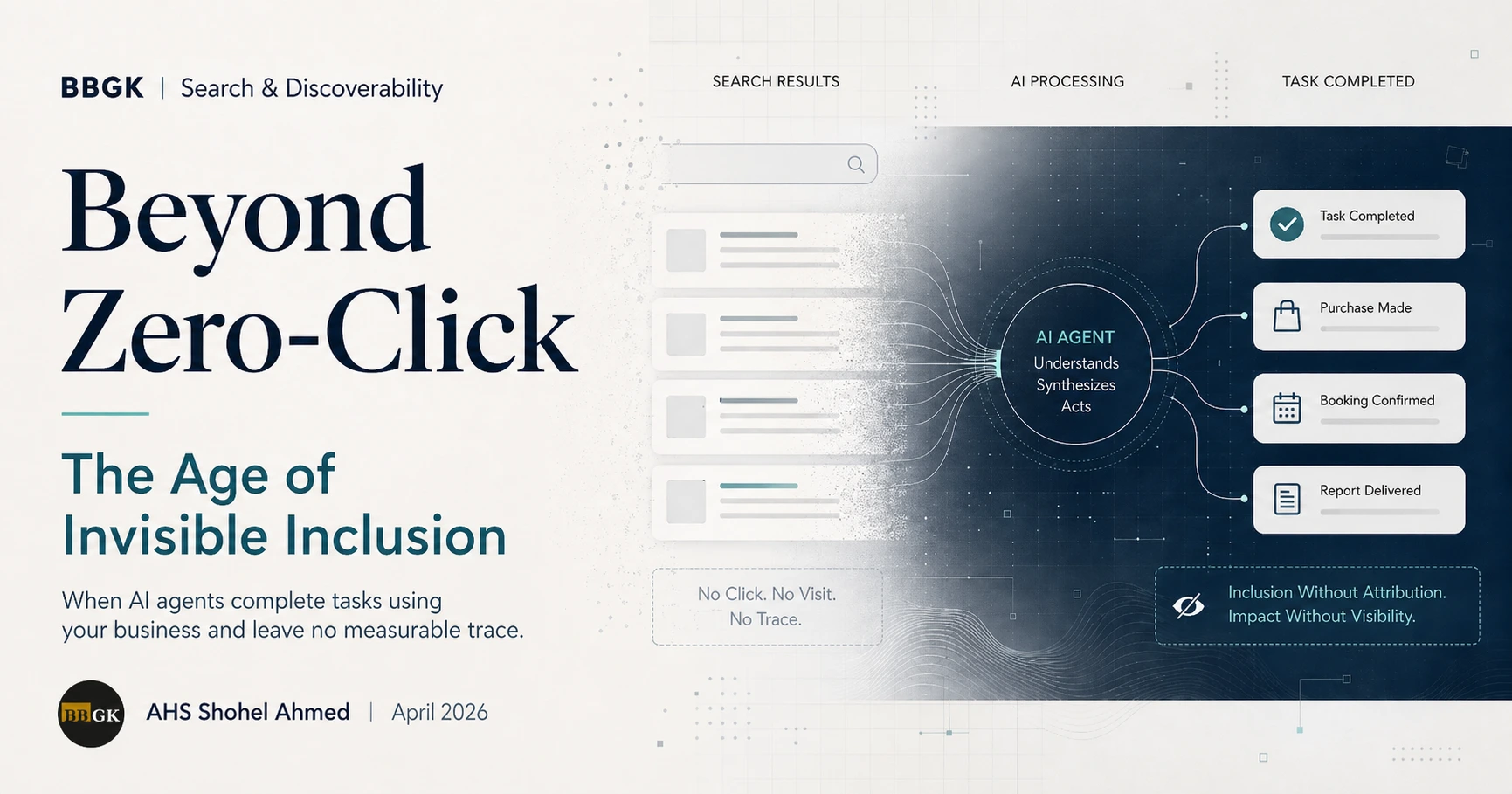
- Beyond zero-click search, visibility is moving from observable exposure to invisible task completion. Businesses can be used by AI systems without receiving clicks, referrals, impressions, or attribution.
- Zero-click search reduced traffic but still preserved observable exposure. Invisible inclusion removes the observable signal itself.
- The defensible response is not platform-chasing. It is sustained validation: entity clarity, structured data health, verified presence, machine-readable facts, and authority signals that remain useful across multiple AI systems.
Core BBGK argument
The product features are verified. The measurement consequences are the strategic inference. That distinction matters.
In the current search environment, a hotel’s pricing can be pulled into an AI-generated travel plan. A local retailer’s inventory can be checked by an agent calling on behalf of a shopper. A travel publisher’s editorial work can help shape an itinerary without receiving a click, referral, or visible attribution.
The task is completed. The user gets what they need. But the business – the hotel, the retailer, the publisher, or the local service provider – may receive no notification, no referral, no impression, and no standard analytics signal that any of it happened.
This is no longer a theoretical concern. In April 2026, Google described several features that move Search further into task completion: AI Mode trip planning with Canvas, individual hotel price tracking, and Google calling local stores on behalf of users. These features are designed around user convenience. They are not designed primarily around business attribution.
This is the real shift beyond zero-click search: not just fewer visits, but hidden participation. We need a name for this condition. The name is invisible inclusion.
Definition
Invisible inclusion is the condition in which AI systems use a business’s data, inventory, pricing, availability, content, or identity signals to complete a user task without generating a visible attribution signal, referral, impression, or confirmation that the business was involved.
Beyond Zero-Click Search: What the Old Model Missed
For the better part of a decade, zero-click search was the defining concern of search visibility strategy. Featured snippets, knowledge panels, answer boxes, and AI Overviews could satisfy the user directly on the results page. Clicks declined, but the basic structure of visibility remained legible.
Your content appeared. Your brand was present. Search Console could often show impressions. You could observe the queries triggering exposure. Even when traffic disappeared, there was still evidence that your site or brand had entered the user’s decision environment.
Zero-click search was a redistribution problem. The value of clicks decreased, but a measurable surrogate – the impression – still existed.
Invisible inclusion is different. The AI system may use your data, check your availability, retrieve your content, compare your price, or include your offering in a plan without exposing that participation to you or the user. You may be inside the transaction and still invisible to yourself.
The central distinction
Beyond zero-click search, the problem changes: zero-click reduced clicks but preserved impressions. Invisible inclusion eliminates both.
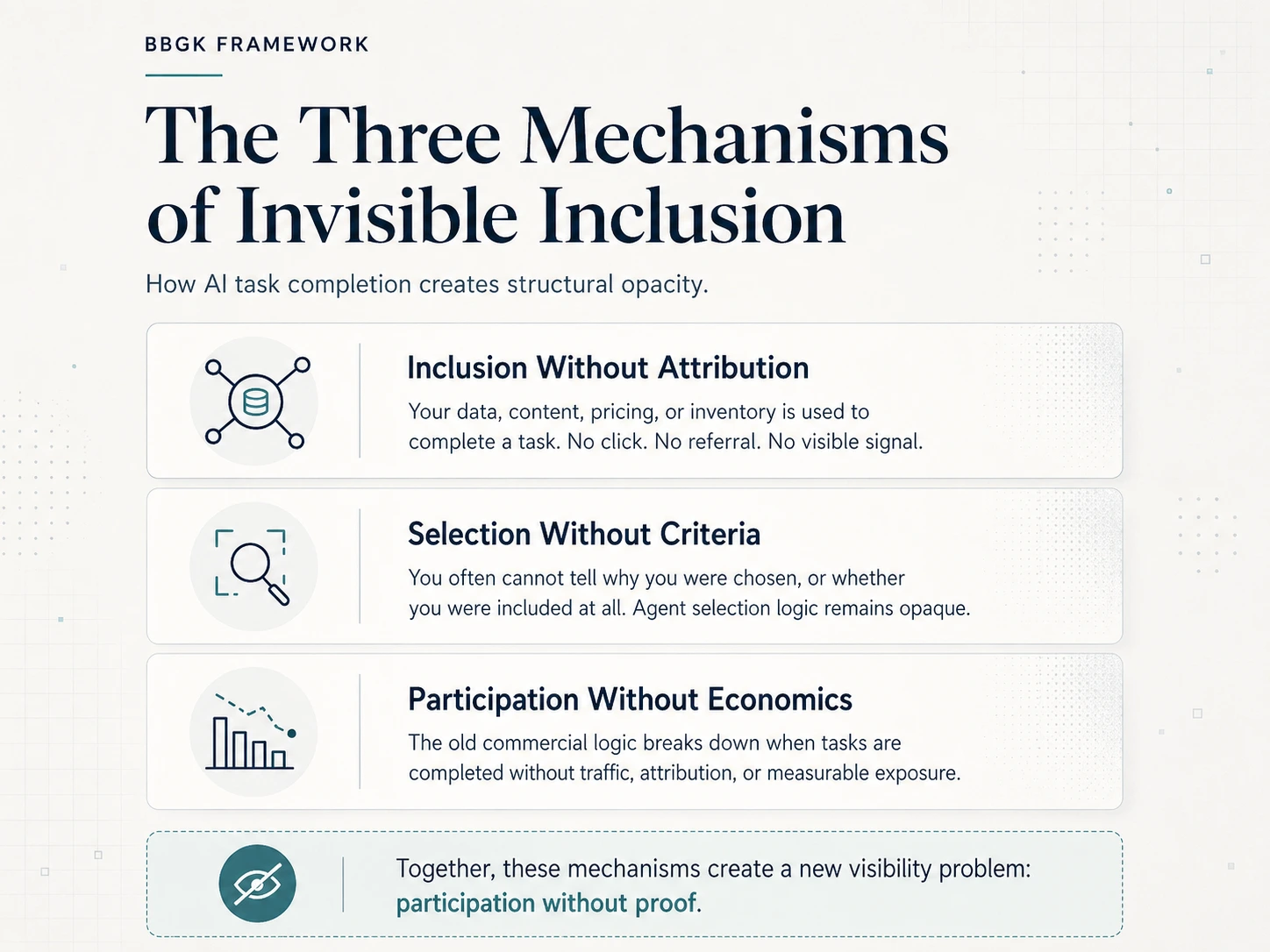
The Three Mechanisms of Invisible Inclusion
| Mechanism | What it means |
|---|---|
| Inclusion without attribution | Your data, inventory, content, pricing, or availability is used by an AI system to complete a task. No click is generated. No referral is fired. No impression is recorded. The business participates in an outcome it cannot trace. |
| Selection without criteria | You do not know why you were included – or whether you were included at all. Agent selection logic is platform-opaque. Structured data, verified profiles, and entity clarity may influence discoverability, but the causal chain to agent selection remains unconfirmed. |
| Participation without economics | The commercial logic that justified visibility investment – clicks creating traffic, traffic creating revenue – does not map cleanly onto agent-completed tasks. Store calling does not produce a click. A travel plan may not cite sources. No platform has defined a replacement model for surfaces where the click never happens. |
These mechanisms operate simultaneously. Together, they produce a condition unlike anything the previous search era created.
A business or publisher can be embedded in an AI system’s output – selected, used, and relied upon – while existing from its own measurement environment as if none of that activity occurred.
The Evidence Is Already Here
Google’s April 2026 product updates provide a useful illustration of how invisible inclusion can operate in practice. Each feature reflects a different part of the same structural problem: AI systems are completing tasks, but businesses do not yet receive a standardized report showing how their data or presence influenced those outcomes.
Canvas trip planning
AI Mode in Search can use Canvas to assemble a travel plan with flights, hotels, attractions, and mapped suggestions. For publishers and travel businesses, the strategic question is not only whether their content ranks. It is whether their content, entity data, or commercial information helps shape a plan without producing a measurable source signal.
Agent-powered store calling
Google can call nearby stores on behalf of users to check whether a specific item is available, including relevant deals. The user receives assistance. The store participates in the discovery process. But the business does not receive a conventional search impression, and Google has not disclosed a transparent eligibility model for which stores are contacted in each case.
Hotel price tracking
Google now supports individual-property hotel price tracking for signed-in users in English and Spanish. A hotel’s pricing can become part of a monitoring and decision process before the hotel ever sees a booking source, referral, or measurable exposure signal connected to that monitoring.
Supporting data – and what it actually proves
Industry data points in the same direction, but they should be interpreted carefully. An April 2026 analysis of AI crawler behavior across 858,457 Duda-hosted sites reported 68.9 million AI crawler visits in February 2026 and found higher crawl rates for sites with more complete local schema and verified business information. That is evidence about AI crawling behavior, not proof that the same signals determine agent calling or AI Mode inclusion.
Publisher data shows a parallel pressure. Index Exchange analyzed activity across 1,200 publishers through 2025 and reported that 69% experienced year-over-year declines in ad opportunities, with an average decline of 14%. The declines were not uniform: health and careers saw sharper drops, while news and politics were more resilient. This does not prove invisible inclusion by itself, but it supports the broader pattern: AI-mediated discovery can weaken the relationship between published value and measurable commercial return.
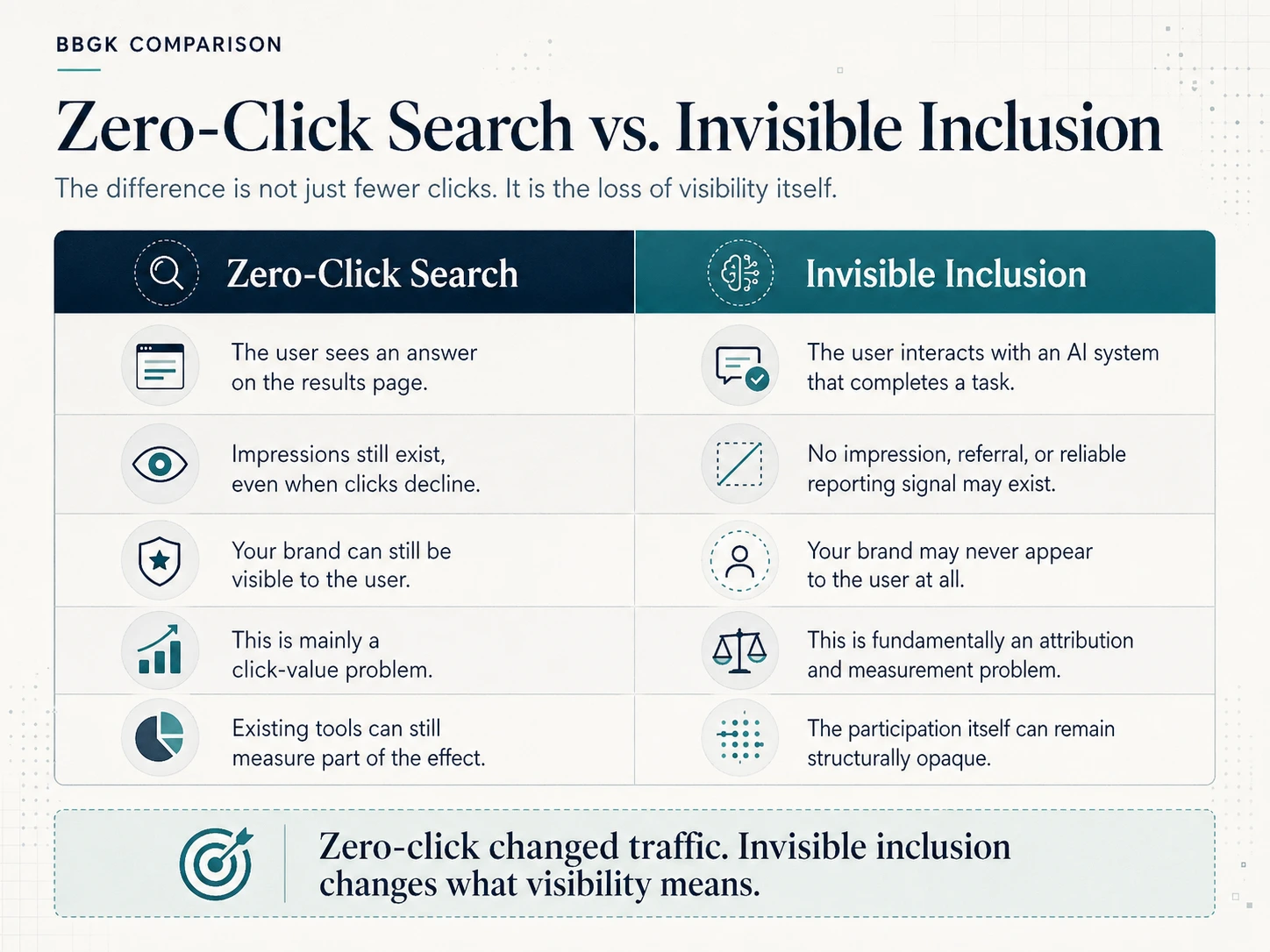
Zero-Click vs. Invisible Inclusion: The Precise Distinction
| Zero-click search | Invisible inclusion |
|---|---|
| User sees a featured snippet, knowledge panel, AI Overview, or answer surface. | User interacts with an AI system that completes a task; there may be no conventional results page. |
| Content can still appear in Search Console with impression data. | No impression may be recorded; no referral may be generated; no standard reporting surface may exist. |
| Brand is often visible to the user even without a click. | Brand name may never appear to the user at all. |
| The problem is redistribution: clicks decline while visible exposure remains. | The problem is attribution: evidence of participation is structurally withheld under current systems. |
| Measurable with existing tools, even if imperfectly. | Not reliably measurable with current analytics because the interaction may leave no observable signal. |
What This Does Not Prove
The argument should not be overstated. Invisible inclusion is a useful framework because it names a real measurement gap. It does not prove every strong claim that could be attached to that gap.
- It does not prove that every AI-generated plan relies on unattributed third-party content.
- It does not prove that structured data guarantees agent selection.
- It does not prove that traditional SEO metrics are useless.
- It does not prove that every AI-mediated interaction harms the business involved.
- It does not prove that all platforms will refuse attribution reporting forever.
The narrower claim is more important: AI task-completion systems can use business data, content, pricing, availability, and identity signals in ways that existing analytics systems cannot reliably observe.
Why the Measurement Gap Is Structural, Not Temporary
It would be comforting to frame the measurement gap as a temporary tooling lag – something that will resolve once platforms build better reporting infrastructure. That may happen eventually. But under current platform design, the gap is more structural than accidental.
Agentic task completion is designed for the user. Google calls stores to help shoppers. Canvas builds itineraries to help travelers. Hotel price tracking helps users monitor deals. The task ends when the user receives a useful outcome, not when the business receives a confirmation signal.
Multi-platform fragmentation compounds the problem. Google, OpenAI, Perplexity, Anthropic, and emerging agent systems use different retrieval methods, different interfaces, different crawlers, different rendering behavior, and different attribution practices. A business may be discoverable to one system and opaque to another.
The training and retrieval layer is improving faster than the reporting layer. Agents are becoming more capable of reasoning, retrieving, calling, browsing, and completing tasks. The measurement infrastructure that would let businesses understand their role in agent outcomes remains underdeveloped.
The measurement gap is not merely a dashboard problem. It is a consequence of systems built to satisfy user intent while often bypassing the reporting mechanisms that supported the previous search economy.
The problem is not delayed reporting. It is that agentic systems can create value from business data without creating a visibility event for the business.
Operating Under Structural Opacity: What Businesses Can Do
Invisible inclusion cannot be solved fully at the business level. Closing the measurement gap requires platform-level reporting that does not yet exist in a standardized form. But businesses can still improve their probability of being understood, selected, and validated by AI systems.
- Maintain entity clarity. Make the business name, location, service area, author identity, ownership, and category signals consistent across the website, Google Business Profile, major directories, social profiles, and trusted third-party references.
- Strengthen structured data health. Use complete, accurate, and validated schema where relevant: Organization, LocalBusiness, Service, Product, FAQPage, Article, Person, BreadcrumbList, and Review schema where appropriate.
- Keep verified profiles current. Business profiles should reflect accurate hours, services, phone numbers, locations, booking options, and operational realities. Outdated profile data is a bigger risk when agents rely on machine-readable facts.
- Make real-time facts accessible. Where applicable, expose inventory, pricing, availability, appointment rules, booking paths, and service constraints in formats that machines can retrieve and humans can verify.
- Build attributable content. Publish content under clear authorship, with topical depth, internal links, update dates, and source references. Agents need to know not only what a page says, but why it should be trusted.
- Track indirect signals. Watch branded search, direct traffic, assisted conversions, call patterns, booking-source ambiguity, review velocity, and question patterns from customers. Invisible inclusion may show up indirectly before it appears in any platform dashboard.
- Preserve server-side evidence. Where possible, monitor server logs, AI crawler access, unusual user agents, API calls, referral anomalies, and bot behavior. This will not solve attribution, but it improves situational awareness.
- Avoid platform-specific overfitting. Do not rebuild the visibility strategy around one AI surface. Build durable signals that travel across systems: clarity, structure, freshness, authority, and verifiability.
Strategic implication
The next visibility challenge is not only whether your brand appears in search. It is whether your business can be selected, used, and acted upon by AI systems without producing a measurable visibility signal.
The Sustained Validation Model in a Post-Attribution Environment
The Sustained Validation Model argues that the goal is no longer ranking in a single system. The goal is maintaining validated presence across the full ecosystem of surfaces where authority, relevance, and trust are assessed.
Invisible inclusion extends the problem the Sustained Validation Model addresses. You cannot always confirm presence on the surfaces that matter most. Some channels may use your signals without producing a signal back to you.
This does not weaken the model. It makes the model more necessary. If measurement is incomplete, the strongest defensible strategy is to strengthen the signals that remain useful across many retrieval environments: entity clarity, structured data, verified business presence, author credibility, source quality, and consistent topical authority.
The practical implication is straightforward: invest in signals that are structurally useful across agent architectures rather than optimizing only for the retrieval preferences of one platform. Those preferences will shift. The quality and consistency of the underlying signal is the more durable position.
Related BBGK context: this framework connects to Search Everywhere Optimization in 2026 for distributed visibility, SEO Is No Longer About Ranking for AI-era citation and trust, the AI Decision Boundary Framework for automation oversight, Knowledge Distance for the limits of domain transfer, and Continuous Partial Attention for the human cost of systems that compress answers and decisions.
Who Should Pay Attention
| Mechanism | What it means |
|---|---|
| Local businesses | AI agents can call, compare, or validate local availability without producing a search referral. Accuracy across profiles, hours, services, and phone handling becomes part of discoverability. |
| Hotels and travel brands | Price tracking, trip planning, and agentic booking can influence demand before the hotel sees a clear attribution path. |
| Publishers | Editorial work can inform AI-generated summaries or plans while weakening the link between content value and traffic value. |
| Ecommerce retailers | Inventory, pricing, and availability signals may be used for selection even when the user never visits the retailer’s site first. |
| SEO and growth teams | Reporting must expand beyond rankings and clicks into entity health, structured data integrity, AI crawler behavior, and indirect demand signals. |
A Closing Observation
For most of search history, invisibility was a simple condition: you were not there. Your site did not rank. Your content was not surfaced. Your business was not selected. The solution was familiar: improve the quality of the signal until you became visible.
Invisible inclusion breaks that logic. You can be fully embedded in the transaction – selected, relied upon, and operationally present in the AI’s output – while remaining invisible to your own measurement systems.
There may be no ranking to improve, no impression to inspect, no referral to trace, and no report to export. The question of whether you were “there” no longer has a clean answer.
This is the defining measurement challenge of the task-completion era. The industry does not yet have stable language for it. The platforms have not standardized reporting for it. Businesses most affected by it – local retailers, hotels, publishers, ecommerce operators, and service businesses – are already operating inside it.
Naming the problem clearly is the first step toward thinking about it usefully. Invisible inclusion is what happens when the cost of being used without being seen becomes invisible too.
Invisible Inclusion: Frequently Asked Questions
What is invisible inclusion in AI search?
Invisible inclusion is the condition in which AI systems complete tasks – such as checking availability, comparing prices, assembling plans, or retrieving content – using a business’s data, inventory, content, or identity signals without generating a visible attribution signal, referral, impression, or confirmation that the business was involved.
How is invisible inclusion different from beyond zero-click search?
Zero-click search reduced clicks but still preserved visible exposure. A featured snippet, knowledge panel, or answer result could still create an impression and brand presence. Invisible inclusion can remove both the click and the observable impression. The business may participate in the outcome without knowing it was selected.
What are the three mechanisms of invisible inclusion?
The three mechanisms are inclusion without attribution, selection without criteria, and participation without economics. Together, they describe a system in which businesses can be used by AI systems without a clear explanation of why they were selected or how that participation created value.
What can businesses do about invisible inclusion?
Businesses cannot fully solve the measurement gap alone. They can improve the signals AI systems are likely to rely on: structured data health, verified business profiles, entity clarity, machine-readable facts, authoritative content, accurate service information, and consistent third-party references.
Why is the measurement gap structural rather than temporary?
The gap is structural under current platform design because agentic task completion is optimized for user convenience, not business reporting. AI systems call stores, assemble itineraries, track prices, and retrieve information to satisfy the user. Standardized reporting for these agent surfaces has not yet emerged.
Does invisible inclusion mean SEO is dead?
No. It means SEO has to expand. Rankings and clicks still matter, but they are no longer enough. Businesses also need entity-level clarity, structured data, verified presence, and content that can be understood and validated across AI-mediated surfaces.
Author Bio
AHS Shohel Ahmed
Shohel Ahmed is the founder of BBGK – Beyond Boundaries Global Knowledge – an independent insight platform producing original analysis on AI and human judgment, search transformation, and the human consequences of modern systems. His work focuses on helping founders, strategists, and decision-makers understand what is actually changing in technology, and what those changes mean for judgment, trust, and long-term authority.
