Emotional erosion refers to the gradual exhaustion caused not by excessive work, but by prolonged emotional misalignment. It occurs when individuals must repeatedly adjust, explain, or accommodate without being fully understood, recognized, or met halfway. Unlike burnout, which stems from workload, emotional erosion develops through unreciprocated emotional labor—being heard without being acknowledged, flexible without reciprocity, and productive without recognition. Over time, this leads to withdrawal rather than anger, marked by quiet disengagement and the internal decision to stop explaining. Because its cause is relational rather than physical, rest alone does not resolve emotional erosion; clarity and shared understanding are required.
Key Insight
- Emotional erosion is not caused primarily by workload, but by prolonged emotional misalignment.
- It builds through repeated adjustment, invisible emotional labor, and lack of reciprocity.
- When exhaustion is relational, rest may ease symptoms but not resolve the cause.
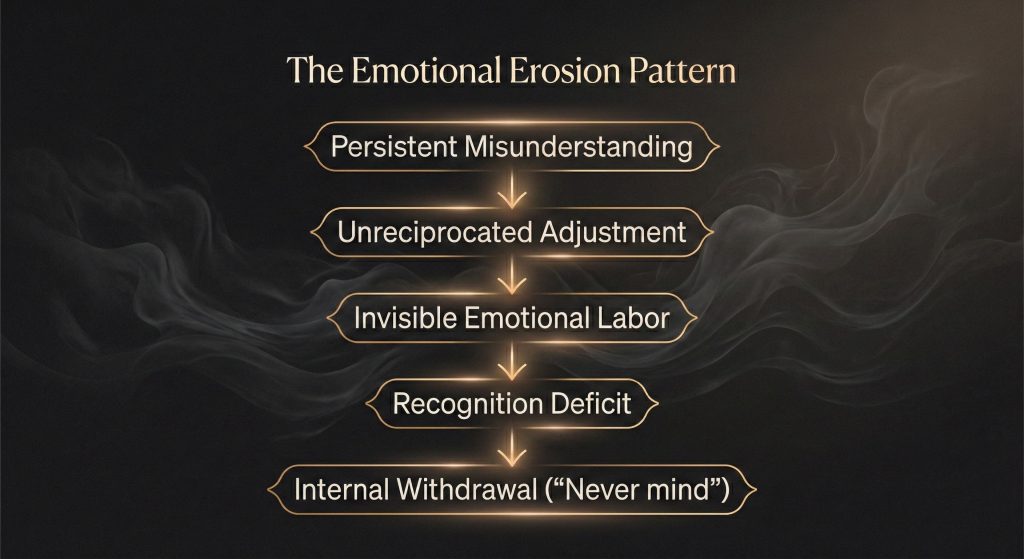
The Emotional Erosion Framework (Core Insight)
Emotional erosion tends to follow a recognizable pattern:
- Persistent Misunderstanding – Being heard without being met
- Unreciprocated Adjustment – One-sided flexibility over time
- Invisible Emotional Labor – Continuous effort without acknowledgment
- Recognition Deficit – Output noticed, presence ignored
- Internal Withdrawal – “Never mind” as self-protection
This sequence explains why rest alone fails — and why many high-functioning individuals feel exhausted even when their workload is reasonable.
Where Emotional Erosion Takes Hold
In Workplaces
In many organizations, the work gets done.
But recognition doesn’t.
What remains instead are comparisons, subtle dismissals, unspoken expectations, and shifting goalposts. People are encouraged to be proactive, adaptable, collaborative — while being evaluated through opaque standards that change without warning.
This is not workload.
This is erosion.
The emotional labor of reading between lines, managing perceptions, and performing professionalism while absorbing disregard does not appear on job descriptions. It earns no overtime pay. Yet it drains more deeply than tasks ever could.
Emotional intelligence research underscores that difficulty managing emotions and misunderstandings in interpersonal settings can erode cognitive and relationship resources, contributing to exhaustion that is not strictly the result of workload.
In Families and Close Relationships
Here, erosion cuts deeper.
You speak — and no one listens.
You stay quiet — and you’re told you’ve changed.
Expression is punished. Silence is interpreted. No version of you seems acceptable.
So adjustment becomes habitual:
- Tone is softened
- Timing is reconsidered
- Needs are postponed
Not because clarity is lacking — but because clarity keeps failing.
This is where emotional labor becomes personal. And personal labor is the hardest to recover from.
In Repeated Misunderstanding
Being misunderstood once is frustrating.
Being misunderstood repeatedly is destabilizing.
Especially when:
- Words are acknowledged but not integrated
- Intent is continually reinterpreted
- Explanations produce no movement
Over time, the mind stops preparing explanations — not from indifference, but from calculation. Explaining has become a losing transaction.
In many cases, that exhaustion is intensified by continuous partial attention, where the mind remains cognitively active without ever fully settling.
The Hidden Cost of Continuous Self-Adjustment
One of the most exhausting human acts is not effort.
It is self-modification.
We grow tired not because we do too much, but because we constantly adjust, clarify, soften, translate, and apologize for things we did not break.
This kind of labor has no leave policy, no recovery window, and no visible metric. Yet it quietly shapes how people disengage, withdraw, or disappear emotionally while still appearing functional.
Contemporary research on emotional labor shows that repeated “surface acting”—suppressing and displaying emotions for organizational norms—can generate sustained psychological strain even when performance appears successful, pointing to an unseen source of workplace fatigue that resembles emotional erosion rather than task overload.
The Most Dangerous Moment Isn’t Anger
Anger still hopes to be heard.
Sadness still expects response.
The most dangerous moment is neutrality.
It is when someone stops reacting, stops explaining, stops asking — and quietly says, “Never mind.”
This is not peace.
It is resignation.
It signals a conclusion has been reached: engagement costs more than withdrawal. Once this internal calculation is made, recovery becomes far more difficult — because the erosion has been internalized.
A Necessary Reframe
From the outside, emotional erosion can resemble laziness, withdrawal, or loss of ambition. From the inside, it feels like carrying weight that was never meant to be held alone.
Those experiencing it are often advised to toughen up, communicate better, or become more resilient. But resilience does not repair chronic misalignment, and strength does not require silent endurance.
You are not tired because you are weak.
You are tired because too much responsibility has been placed on your internal regulation rather than shared understanding.
This is not a personal failure.
It is a systemic imbalance.
Naming it does not solve everything — but it restores accuracy. And sometimes, accuracy is the first form of relief.
Closing Thought
Work ends.
People don’t.
And when exhaustion comes from people, rest is not the cure — clarity is.
Not confrontation.
Not withdrawal.
But the clarity to understand what you are carrying — and why it feels heavier than it should.
Emotional erosion is not loud, not dramatic, and not easily diagnosed — but it is one of the defining psychological costs of modern life.
This pattern also helps explain why Americans over 40 feel more exhausted than ever, particularly when prolonged emotional strain is mistaken for ordinary tiredness.