

The end of the year invites a particular kind of pressure.
Not urgency — pressure.
A quiet insistence that something must be corrected, optimized, improved. That the coming year should begin with renewed discipline, sharper habits, clearer goals, and a better version of the self who carried the last twelve months. Even without consciously buying into resolution culture, many adults absorb its expectations by proximity.
For people over 40, this pressure rarely feels energizing. It feels heavy.
Not because growth is unwanted, but because the demands we place on ourselves often lag behind the realities of midlife. Expectations that once aligned with expansion — more ambition, more capacity, more flexibility — quietly fall out of sync with a life structured around responsibility, continuity, and limited recovery. Yet those expectations persist, enforced by habit, cultural messaging, and the fear that easing pressure equals decline.
Midlife is not a moment of collapse. It is a phase of density. Fewer unknowns, but more weight. Less chaos, but more consequence. The self that enters each new year is not starting fresh; it is carrying accumulated roles, obligations, and unfinished psychological threads from years before.
This essay is not about lowering standards or withdrawing from effort. It is about discernment. About identifying which internal demands no longer support recovery, clarity, or meaning — and understanding why releasing them is not resignation, but recalibration.
Below are five demands many people carry into each new year without questioning. Letting go of them does not promise ease or transformation. But it removes unnecessary strain — the kind that quietly drains energy long before anything appears obviously “wrong.”
This essay outlines five things to stop demanding from yourself after 40 — not as an act of resignation, but as a recalibration grounded in how midlife actually works.
1. Stop Demanding Constant Motivation
Motivation is one of the most misunderstood forces in adult life.
In early adulthood, motivation often feels abundant and reliable. Novelty is high. Rewards are frequent. Progress is visible. The brain’s reward system responds quickly to effort, and enthusiasm feels like a reasonable prerequisite for action. Energy arrives first; action follows.
After 40, that equation quietly changes.
Neuroscience research shows that dopamine — the neurotransmitter involved in reward anticipation and motivation — becomes less responsive to novelty over time. Research synthesized through the National Institutes of Health shows that dopamine-driven motivation is highly sensitive to novelty and reward prediction.
This is not a defect or a decline in capacity. It is an efficiency shift. The brain learns what is familiar and stops reacting to it with the same chemical urgency. Motivation becomes contextual rather than constant, tied to meaning, relevance, and structure instead of excitement.
In practical terms, this means that waiting to feel motivated before acting becomes increasingly unreliable in midlife. Enthusiasm no longer functions as a dependable ignition switch.
Yet many adults continue to treat motivation as a moral prerequisite — as if action without desire signals something broken.
This misunderstanding fuels unnecessary self-judgment:
- Why don’t I feel driven anymore?
- Why does everything feel heavier to start?
What is often missing is not motivation, but permission to operate without it.
It helps to be clear about what motivation is not:
- It is not a stable personality trait
- It is not a measure of commitment or character
- It is not designed to be present before every meaningful action
By midlife, sustained effort depends less on emotional ignition and more on scaffolding: routines that function when energy fluctuates, values that guide action without requiring excitement, and systems that reduce the need for constant internal negotiation.
Research synthesized through the National Institutes of Health shows that dopamine-driven motivation is highly sensitive to novelty and reward prediction, and that its signaling patterns shift with repeated exposure and age — reinforcing the idea that motivation naturally becomes more selective over time rather than permanently available (PubMed Central).
Releasing the demand for constant motivation does not reduce output. In many cases, it stabilizes it. Because motivation, when treated as optional rather than mandatory, returns in quieter, more sustainable forms — no longer as a spark to chase, but as a signal to respect.
2. Stop Demanding Linear Progress
Much of modern culture assumes progress should look like ascent.
More clarity each year. More success. More confidence. Fewer doubts. A steady upward trajectory that validates effort and justifies sacrifice. This model works reasonably well in early adulthood, when life is structured around accumulation — of skills, credentials, income, and options.
But human development does not move in straight lines — especially in midlife.
Research in developmental psychology and life satisfaction consistently shows that the middle decades are defined less by expansion and more by integration. Responsibilities stabilize. Roles deepen. The work shifts from building something new to sustaining, coordinating, and protecting what already exists. Growth continues, but it becomes less visible and harder to quantify.
This is where expectations often fall out of sync with reality.
In simple terms, progress changes shape:
- Early adulthood: progress feels additive — more options, faster feedback, clearer milestones
- Midlife: progress becomes integrative — balancing, maintaining, refining, and absorbing complexity
- Outcome: effort remains high, but external markers appear less frequently
From the outside, this phase can resemble stagnation. From the inside, it often feels disorienting. Advancement slows. Some ambitions soften. Others quietly expire, not because they failed, but because they no longer fit the structure of life as it exists.
When linear progress is treated as the only legitimate narrative, these shifts register as personal failure.
They are not.
They represent a transition from accumulation to integration — a phase where maintaining coherence across multiple responsibilities requires as much energy as pursuing visible advancement once did. Data from the Pew Research Centerconsistently shows that life satisfaction often dips in midlife before rising again later, reinforcing the idea that this period reflects strain and consolidation rather than decline.
Letting go of linear expectations allows progress to be redefined — not as more, but as steadier. Not as expansion, but as alignment.
3. Stop Demanding Emotional Availability at All Times
By midlife, many adults become emotional infrastructure.
They are the ones others rely on. The steady presence. The problem-solver. The listener. The buffer between chaos and collapse. At work. At home. In extended families.
This role rarely begins as a conscious choice. It develops gradually and invisibly. Responsibility accrues. Availability becomes assumed. Saying “yes” feels easier than renegotiating expectations — especially when competence and reliability have already been established.
Over time, emotional labor accumulates: the ongoing effort of monitoring moods, absorbing tension, managing reactions, and maintaining stability for others. Unlike task-based work, this labor has no clear endpoint. It does not announce completion. It simply continues.
Psychological research summarized by the American Psychological Association shows that sustained emotional labor contributes to chronic stress and exhaustion, even in otherwise stable lives.
In midlife, emotional availability often expands quietly into places such as:
- being the default mediator in conflicts
- anticipating others’ needs before they are expressed
- carrying unspoken worries for family members or teams
- staying emotionally steady so others don’t have to
Psychological research summarized by the American Psychological Association shows that sustained emotional labor, particularly when unacknowledged or unbounded, contributes to exhaustion even in the absence of overt stressors. It is draining precisely because it is continuous and relational rather than episodic.
Demanding constant emotional availability leaves little space for psychological rest — the rare state of being unneeded, unresponsive, and off-duty. Releasing this demand does not mean withdrawing from relationships. It means recognizing that presence requires replenishment, that empathy has limits, and that availability without pause slowly erodes itself.
4. Stop Demanding Immediate Clarity
Midlife decisions carry different weight.
Choices feel less reversible. Timelines feel tighter. Consequences feel more permanent. This naturally increases internal pressure to “figure things out” quickly — to arrive at clarity before uncertainty becomes uncomfortable.
What often goes unrecognized is how decision load changes after 40. Decisions are no longer isolated. They interact with existing commitments, financial structures, relationships, health considerations, and long-term consequences. Each choice must account for multiple systems already in motion. The mind is not only deciding; it is coordinating.
Research in decision psychology shows that when cognitive load is high, forcing rapid clarity often backfires. Instead of insight, it produces compression — premature conclusions reached to relieve discomfort rather than reflect reality.
Clarity tends to take longer in midlife because:
- decisions involve more stakeholders, not just the self
- options are constrained by prior commitments
- outcomes carry longer time horizons
- uncertainty has higher emotional cost
Yet many adults interpret delayed clarity as incompetence:
I should know by now.
I shouldn’t still be unsure.
This expectation misunderstands how cognition works under complexity. Psychological research on cognitive load summarized by the American Psychological Association shows that as mental load increases, effective decision-making benefits from slower processing, reflection, and incubation rather than immediate resolution.
Letting go of the demand for instant clarity creates space for gradual understanding. It accepts that not knowing is sometimes the most accurate response — and that clarity often emerges after pressure eases, not while it is being applied.
5. Stop Demanding Endless Resilience
Resilience has become a cultural virtue.
Be strong. Adapt. Push through. Handle it.
In midlife, resilience is often treated as proof of competence — the ability to keep functioning regardless of load. But resilience is not a personality trait or a moral achievement. It is a physiological and psychological outcome, dependent on recovery, regulation, and the nervous system’s ability to stand down after strain.
This is where an important distinction is often lost: resilience and recovery are not the same thing.
Stress research shows that human systems can remain operational under prolonged strain while still accumulating damage. People keep showing up. Responsibilities are met. Deadlines are handled. From the outside, nothing appears broken. What quietly disappears is surplus capacity — the margin that allows effort to feel sustainable rather than extractive.
Endless resilience assumes that endurance alone is sufficient — that recovery can be postponed without consequence. In reality, resilience without recovery gradually turns into depletion. The system does not collapse; it thins.
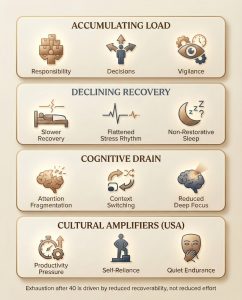
This pattern sits at the core of midlife exhaustion after 40: years of competence, reliability, and self-control layered without adequate restoration. Not dramatic burnout. Not crisis. Just a steady erosion of recoverability.
Research synthesized through the National Institutes of Health shows that chronic stress alters stress-response systems and slows physiological recovery, making it harder for the body to return to baseline even when external demands remain unchanged (PubMed Central).
Letting go of the demand for endless resilience allows strength to be redefined. Not as constant endurance, but as the ability to pause, recalibrate, and recognize limits as information — not failure.
What You’re Allowed to Leave Behind
Entering 2026 does not require a reset.
It requires discernment.
The demands that once propelled growth may now be quietly undermining recovery. Releasing them does not mean lowering standards or abandoning responsibility. It means updating expectations to match reality — biological, psychological, and contextual — rather than continuing to enforce rules written for an earlier phase of life.
By midlife, the cost of holding outdated demands is no longer theoretical. It is cumulative. Expectations persist not because they still serve, but because they have gone unquestioned. This is how unnecessary strain survives even when effort remains sincere.
You are allowed to stop demanding:
- constant motivation
- visible upward progress
- uninterrupted availability
- immediate certainty
- limitless resilience
Not because you are weaker than before — but because you are carrying more, for longer, with fewer opportunities to fully power down. Responsibility has become continuous. Recovery has become conditional. The imbalance is structural, not personal.
Understanding this does not solve everything. But it corrects the framing. It moves the internal conversation away from self-correction — what’s wrong with me? — and toward self-accuracy — what is this phase actually asking of me?
And sometimes, that shift matters more than solutions. Because clarity does not always reduce the load — but it can stop you from adding to it unnecessarily.