
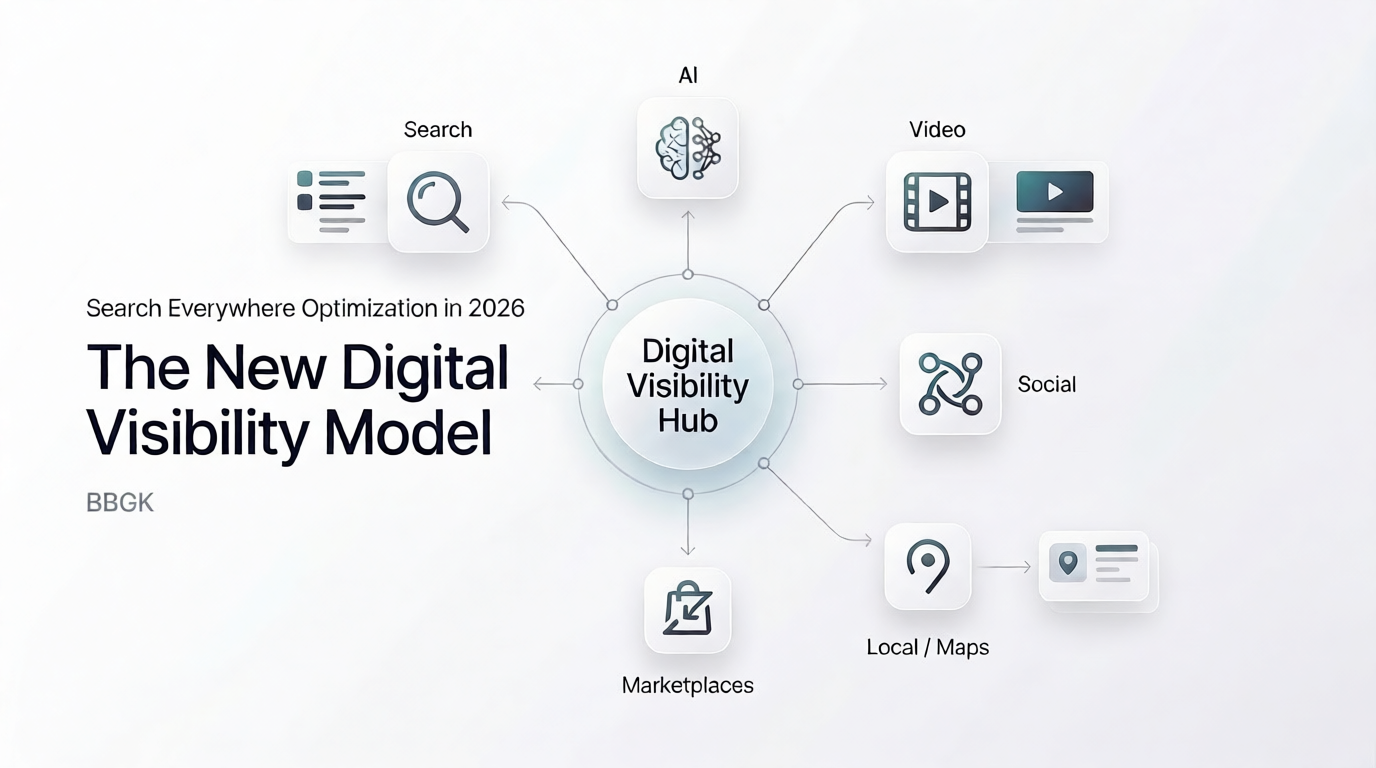
Search no longer happens in one place.
For years, digital visibility was treated as a Google problem. Today, that is too narrow to be useful. The fundamentals still matter, and Google’s guidance on AI features and your website makes clear that AI visibility still sits on top of core search eligibility, useful content, and strong site fundamentals.
Search Everywhere Optimization is the discipline of making a brand discoverable, understandable, and recommendable wherever digital decisions are shaped.
In 2026, digital visibility is no longer a single-platform problem. It is a cross-platform system shaped by ranking, recommendation, answer extraction, platform-native discovery, and trust. The brands that win are not just visible in one place. They are easier to find, easier to interpret, and easier to choose across the places where discovery now happens. Google Search Essentials and Google’s AI features guidance both reinforce the same direction: build for accessibility, clarity, usefulness, and discoverability rather than chasing fictional “AI hacks.”
Key Takeaways
- Search Everywhere Optimization is broader than SEO. It includes search visibility, answer extraction, AI interpretability, social discovery, video discoverability, local visibility, and marketplace readiness.
- The real shift in 2026 is not just where people search. It is where decisions get shaped before the click.
- AI visibility is not a separate technical game. Strong fundamentals, clear structure, useful text, and trustworthy content still matter most.
- Modern visibility works like a stack. Technical eligibility, content extractability, authority, platform-native packaging, and reinforcement all affect whether content gets found and chosen.
What Search Everywhere Optimization Means Now
Search Everywhere Optimization does not mean “be everywhere.”
That sounds ambitious, but it is not a strategy. Random presence is not visibility. Existence is not discovery. Indexing is not selection. Uploading is not distribution.
A better definition is this: Search Everywhere Optimization is the practice of making your content and brand easy to find, easy to understand, and easy to trust across the platforms that shape real discovery.
That includes traditional search engines, AI-supported search experiences, YouTube, social search, local listings, map-based discovery, and transactional platforms. The goal is broader than rankings alone. It is to make your brand:
- easy to find
- easy to interpret correctly
- easy to surface in the right contexts
- easy to trust when a choice must be made
Takeaway: Search Everywhere Optimization is not about publishing everywhere. It is about reducing friction between discovery and decision.
SEO vs AEO vs GEO vs Search Everywhere Optimization
These terms overlap, but they solve different visibility problems. Treating them as interchangeable leads to shallow strategy.
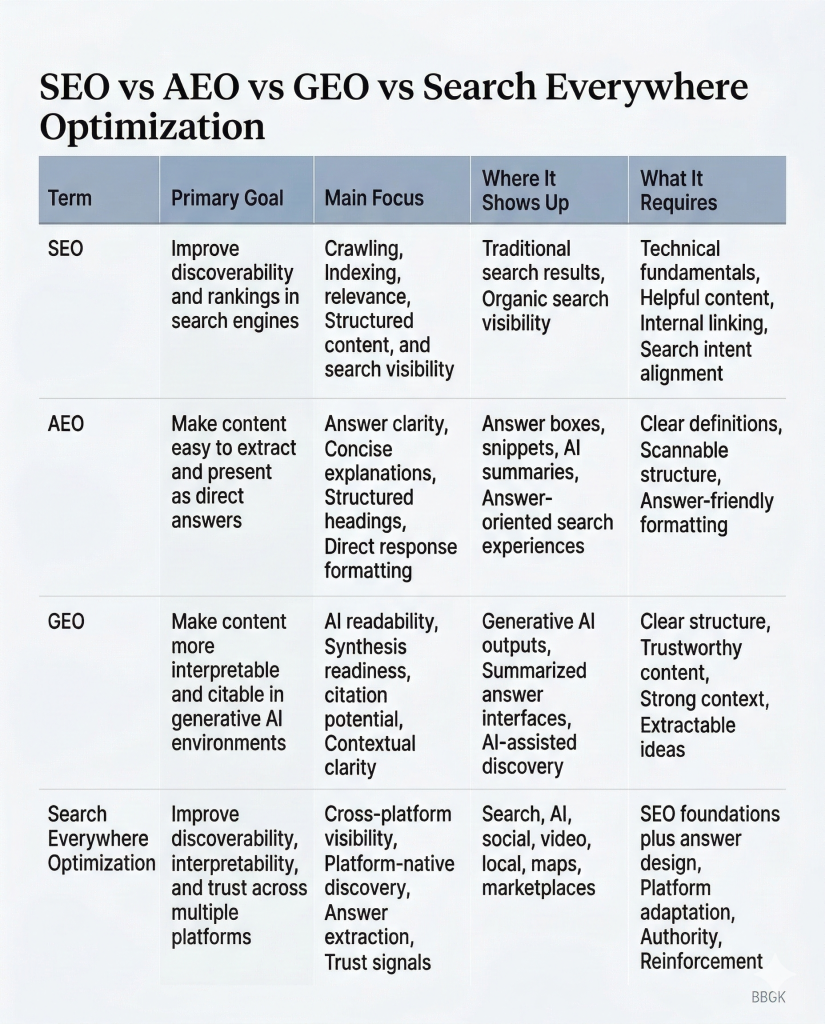
Traditional SEO focuses on helping content get crawled, indexed, understood, and ranked in search engines. It remains foundational, and Google Search Essentials still define the baseline conditions for eligibility and performance.
AEO, or Answer Engine Optimization, focuses on making content easy to extract, summarize, and present as a direct answer. In practice, that usually means clearer definitions, stronger headings, concise explanations, and obvious answer blocks. Google’s documentation on featured snippets reflects the same reality from the search side: some results surface because a page answers a question clearly and directly.
GEO, or Generative Engine Optimization, is commonly used as a market term for optimizing content for generative AI environments. In practice, that means making content more interpretable, more citable, and more useful inside summarized or synthesized experiences. Google’s AI features guidance supports the underlying principle that clear, accessible, well-structured content is easier for these systems to use, even though Google does not define GEO as a formal product category.
Search Everywhere Optimization is broader than all three. It includes traditional SEO, answer extraction, AI interpretability, video discoverability, social search visibility, local platform visibility, and marketplace readiness.
SEO is still the foundation. Search Everywhere Optimization is the larger operating model built on top of it.
What Changed in Digital Visibility
The biggest change is not that Google disappeared. It did not.
The real change is that discovery fragmented.
People now resolve different intents on different platforms. A person looking for a definition may use Google or an AI-supported search experience. A person looking for a demonstration may go to YouTube. A person looking for fast social proof may search inside TikTok, Instagram, Reddit, LinkedIn, or YouTube. A person ready to buy may go directly to Amazon or another marketplace. A local customer may decide based on maps, categories, reviews, service descriptions, and photos before ever visiting a website.
That means visibility can no longer be managed as one ranking exercise. It has to be managed as a system.
The old model asked, “How do we rank?” The better question now is, “Where does this decision actually get shaped?”
Another major shift is that search and recommendation increasingly overlap. Platforms do not just retrieve. They prioritize, suggest, summarize, and route. Google’s ranking systems guide describes the use of multiple automated ranking systems, while YouTube explains that Search prioritizes relevance, engagement, and quality.
AI accelerated this shift, but it did not erase the fundamentals. Google explicitly says there are no additional technical requirements for appearing in AI features such as AI Overviews or AI Mode beyond normal eligibility for Search.
What makes this more urgent in 2026 is not just that AI exists. It is that AI-supported search experiences, platform-native search, and cross-platform recommendation systems are now shaping how users discover and choose before many clicks ever happen. Google also notes that traffic from AI search features is included in overall Search Console reporting, which means visibility analysis now has to be broader and more integrated.
The Real Shift
The real shift is not simply that people search in more places.
It is that visibility now shapes judgment before traffic happens.
Search engines, AI interfaces, social platforms, maps, and marketplaces do not just send visitors. They frame choices.
That is why modern visibility is no longer only about getting found. It is about being positioned, interpreted, and trusted before the click.
What Did Not Change
This is where many modern visibility discussions become sloppy.
The interfaces changed. The need for clarity, structure, usefulness, and trust did not.
New surfaces changed distribution. They did not change the value of being genuinely useful.
Helpful, Reliable Content Still Matters
Google’s people-first content guidance still emphasizes helpful, reliable information created primarily for people, along with original information, substantial value, and insight beyond what is already obvious on the web.
That means generic rewrites remain weak strategy, even if the formatting looks modern.
Technical Accessibility Still Matters
If a page cannot be crawled, indexed, rendered properly, or connected within the site architecture, visibility weakens before quality even enters the equation. Search Essentials and Google’s in-depth guide to how Search works still sit underneath everything else.
Clear Text Still Matters
Google’s AI features guidance explicitly recommends making important content available in text and supporting it with strong images and video where relevant. That matters because systems cannot surface what they cannot clearly interpret.
Internal Linking Still Matters
Google directly recommends making content easy to find through internal links. This is not a minor housekeeping issue. It is part of how your site teaches relevance and relationships.
The interfaces changed. The need for clarity, structure, usefulness, and trust did not.
The 5-Layer Digital Visibility Model
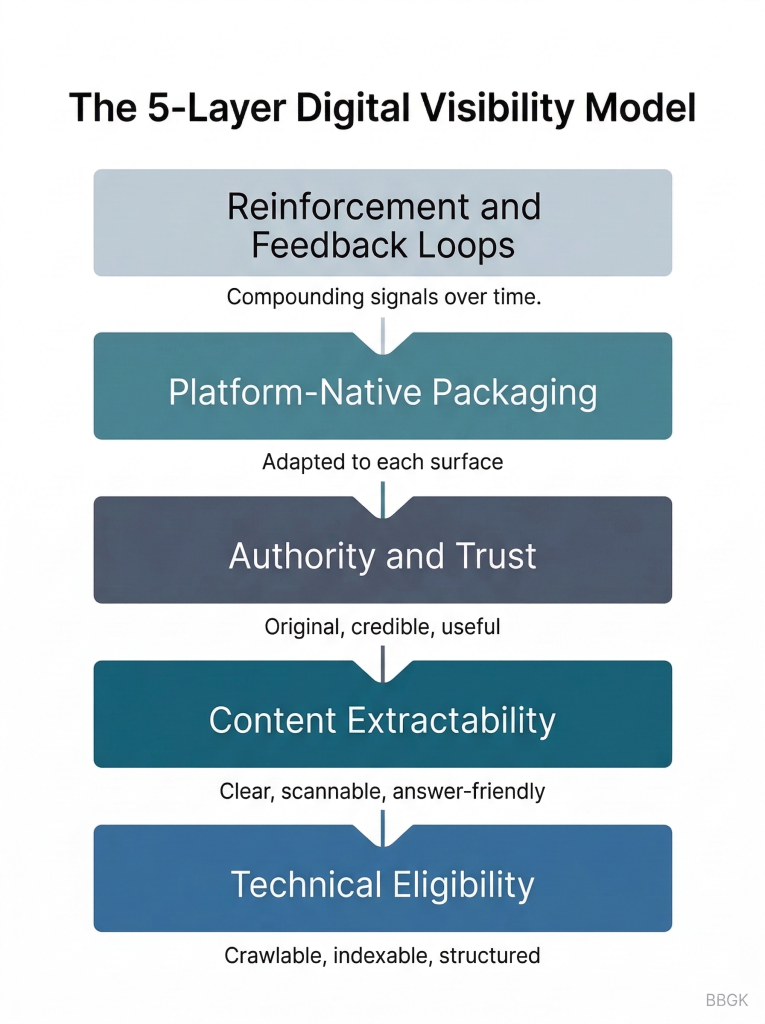
Think of visibility as a stack: if the lower layers are weak, the upper layers become harder to sustain.
1. Technical Eligibility
What It Is: The basic ability of a page or asset to be crawled, indexed, rendered, and surfaced.
Why It Matters: If a page cannot be cleanly accessed or understood, visibility weakens before content quality even becomes relevant. Google Search Essentials and the SEO Starter Guide still make this layer non-negotiable.
What Brands Get Wrong: They focus on publishing more while neglecting crawlability, internal linking, mobile readiness, architecture, and snippet eligibility. Google’s JavaScript SEO guidance and mobile-first indexing guidance both show why these basics still matter.
2. Content Extractability
What It Is: The degree to which a page makes its value easy to locate, understand, summarize, and quote.
Why It Matters: Extractable content is easier for people to scan and easier for search systems, AI features, and answer-oriented interfaces to interpret.
If the value is hard to find, it is hard to surface. If it is hard to surface, it is hard to trust.
What Brands Get Wrong: They bury the answer, overdesign the page, or confuse stylish writing with clear communication. Google’s AI features guidance and featured snippets guidance both point toward the value of direct, legible content.
3. Authority and Trust
What It Is: The signals that suggest your content deserves confidence.
Why It Matters: Visibility without trust creates traffic. Trust is what creates action. Google’s people-first content guidance repeatedly points toward original information, useful expertise, and meaningful value.
What Brands Get Wrong: They assume authority comes from sounding professional. Real authority is strengthened by first-hand knowledge, disciplined sourcing, clear authorship, and useful synthesis.
4. Platform-Native Packaging
What It Is: Adapting the presentation of content to the discovery logic of each platform.
Why It Matters: A good article, a good video, a good social post, and a good local profile do not win for exactly the same reasons. YouTube says Search uses relevance, engagement, and quality, while local visibility and website discoverability still depend on useful information and accessible presentation.
What Brands Get Wrong: They publish one asset and scatter it everywhere unchanged. That is distribution, not optimization.
5. Reinforcement and Feedback Loops
What It Is: The way multiple assets, signals, and platforms strengthen one another over time.
Why It Matters: Strong visibility systems compound. A strong article supports a video. A video supports brand search. A local profile reinforces trust. Reviews improve conversion confidence. Internal links strengthen topical pathways.
What Brands Get Wrong: They treat each asset as isolated and then wonder why visibility feels fragile.
Platform-Specific Discovery Still Matters
Search Everywhere Optimization is not only about being present across more surfaces. It is about understanding that discovery behavior changes by platform.
On Google, people often search with explicit intent and expect direct relevance.
On YouTube, search is often tied to explanation, demonstration, and problem-solving.
On social platforms, discovery is shaped more by recommendation, conversation, and social proof.
On marketplaces, visibility depends on conversion signals, reviews, categorization, and transactional relevance.
On AI systems, visibility increasingly depends on whether content is clear enough to be summarized, trusted, and cited.
The implication is simple: visibility is no longer one ranking problem. It is a multi-surface interpretation problem.
Search behavior is also becoming more conversational. People increasingly ask longer, more natural-language questions across AI tools, voice interfaces, and mobile search environments. That shifts the advantage toward content that is not only optimized for keywords, but also structured for explanation, clarity, and retrieval.
As AI systems become a discovery layer of their own, visibility depends less on ranking alone and more on whether content is clear enough to be extracted, summarized, and cited. A deeper discussion of that shift appears in AI Visibility SEO.
Platform-Specific Discovery Still Matters
Search Everywhere Optimization is not only about being present across more surfaces. It is about understanding that discovery behavior changes by platform.
On Google, people often search with explicit intent and expect direct relevance.
On YouTube, search is often tied to explanation, demonstration, and problem-solving.
On social platforms, discovery is shaped more by recommendation, conversation, and social proof.
On marketplaces, visibility depends on conversion signals, reviews, categorization, and transactional relevance.
On AI systems, visibility increasingly depends on whether content is clear enough to be summarized, trusted, and cited.
The implication is simple: visibility is no longer one ranking problem. It is a multi-surface interpretation problem.
Search behavior is also becoming more conversational. People increasingly ask longer, more natural-language questions across AI tools, voice interfaces, and mobile search environments. That shifts the advantage toward content that is not only optimized for keywords, but also structured for explanation, clarity, and retrieval.
As AI systems become a discovery layer of their own, visibility depends less on ranking alone and more on whether content is clear enough to be extracted, summarized, and cited. A deeper discussion of that shift appears in AI Visibility SEO.
What to Measure in 2026
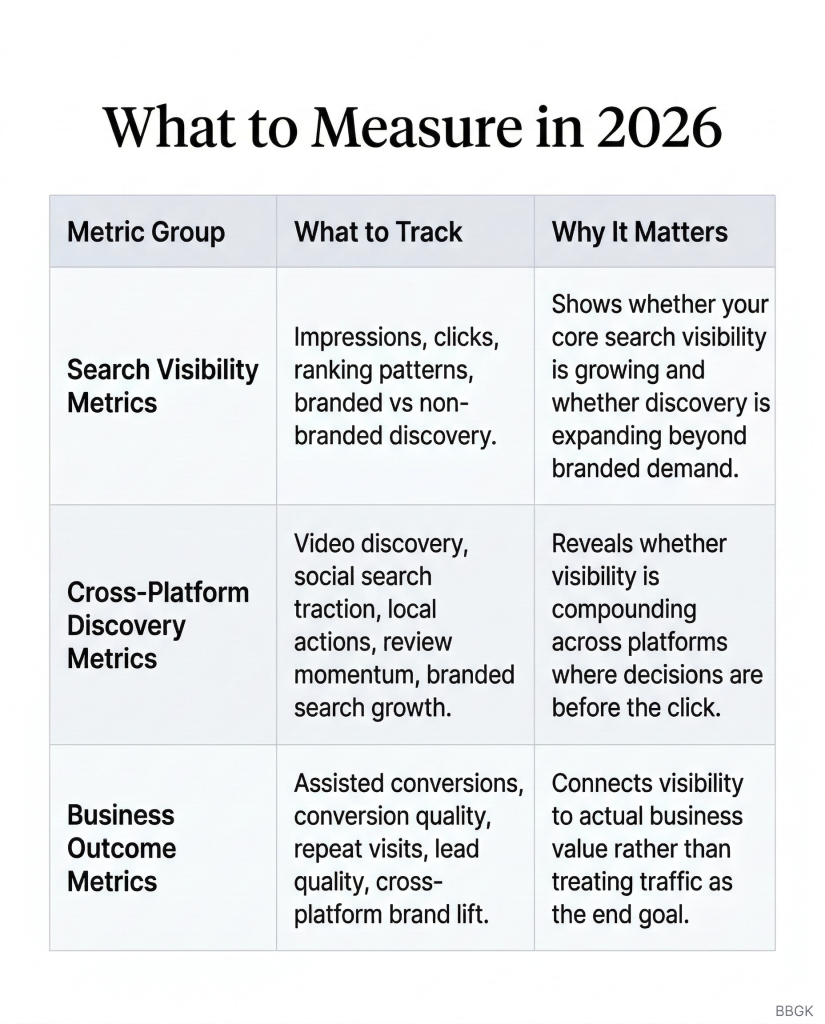
The wrong visibility question is only, “Are we ranking?” The better one is, “Are we becoming easier to discover, easier to trust, and easier to choose?”
Search Visibility Metrics
- impressions
- clicks
- ranking patterns
- branded vs non-branded discovery
Cross-Platform Discovery Metrics
- video discovery
- social search traction
- local actions
- review momentum
- branded search growth
Business Outcome Metrics
- assisted conversions
- conversion quality
- repeat visits
- lead quality
- cross-platform brand lift
Google’s AI features guidance also notes that AI feature traffic is counted within overall Search Console web reporting rather than in a separate isolated report, which makes integrated analysis more important.
A Practical Search Everywhere Optimization Framework
Identify Where Your Audience Actually Searches.
Do not assume every discovery journey starts on Google. Map intent to platform.
Build Content That Is Useful and Extractable.
Make the value easy to understand, easy to scan, and easy to summarize.
Adapt Packaging by Platform.
A webpage, a video, a local profile, and a social post should not all be structured the same way.
Strengthen Trust Signals.
Use clear authorship, disciplined sourcing, reviews, internal links, and meaningful proof.
Measure, Learn, and Refine.
Visibility systems improve through repetition, interpretation, and feedback loops.
Search Everywhere Optimization works best when it is treated as an operating system, not a content checklist.
Checklists help execution. Systems create compounding advantage.
Final Thoughts
Search Everywhere Optimization is not the death of SEO.
It is the correction of an outdated mental model.
SEO is still foundational. But in 2026, visibility no longer lives inside a single platform, a single format, or a single ranking system. It lives across interconnected discovery surfaces where search, AI-supported answers, recommendation systems, social proof, local trust, and platform-native content all influence what gets seen and what gets chosen.
The brands that will win are not the ones chasing every platform equally. They are the ones building a clear visibility system around how people actually discover, evaluate, and choose.
They will not just rank better.
They will become easier to find, easier to trust, and harder to displace.
Frequently Asked Questions
What Is Search Everywhere Optimization?
Search Everywhere Optimization is a multi-platform visibility strategy focused on making a brand discoverable, understandable, and recommendable across search engines, AI interfaces, social platforms, video platforms, local profiles, and marketplaces.
How Is Search Everywhere Optimization Different From Traditional SEO?
Traditional SEO mainly focuses on search-engine discoverability and rankings. Search Everywhere Optimization includes that foundation but expands the model to cover answer extraction, AI interpretability, video discovery, social search, local discovery, and cross-platform trust.
Is Search Everywhere Optimization the Same as GEO?
No. GEO usually refers to optimizing content for generative AI environments. Search Everywhere Optimization is broader. It includes GEO, but also includes classic SEO, platform-native search behavior, local visibility, and multi-channel discoverability.
How Do AI Overviews Change SEO?
They do not replace SEO fundamentals. Google says there are no additional technical requirements for appearing in AI features beyond normal eligibility for Search. What changes is the importance of clearer structure, better text visibility, and stronger usefulness.
What Is the Difference Between Ranking, Being Surfaced, and Being Cited?
Ranking means earning position in a list of results. Being surfaced means being selected by a system for visibility in context. Being cited means your content is used as supporting input in an answer or summary.
Do You Need Separate AI Optimization for Google?
Not in the way many marketers imply. Google says there are no additional technical requirements for appearing in AI features beyond normal Search eligibility, so the better approach is stronger fundamentals, clearer structure, and better content.
FAQ content can still help readers, but FAQ rich results are now limited primarily to government and health sites, so the value of FAQs today is more about clarity and usefulness than rich-result gain. Google’s structured data policies and FAQ documentation explain the current limits.
In 2026, visibility is no longer a channel problem. It is a systems problem.
Editor’s Note: This article was originally published on March 5, 2025, and substantially revised on March 8, 2026 to reflect updated thinking on SEO, AI search, answer engines, and cross-platform digital visibility.