The Risk of Cognitive Dependency in the Age of Artificial Intelligence
Key Takeaways
AI is useful when it extends human thinking. It becomes risky when it replaces the cognitive work behind memory, attention, questioning, judgment, and meaning.
AI Is Changing What We Still Practice
AI is not only changing how fast we work. It is changing which parts of thinking we still practice.
That is the deeper issue behind AI cognitive dependency.
Most public discussion still treats artificial intelligence as a productivity tool. It helps people write faster, search faster, summarize faster, code faster, and produce more output in less time. That is true, but incomplete.
The more important question is whether repeated dependence on AI changes the way people remember, focus, question, decide, and understand. BBGK has already explored this broader issue in AI Cognitive Impacts: How Artificial Intelligence Is Reshaping Human Thinking, where the main point is not that AI changes output, but that it can change the cognitive habits behind output.
A 2025 systematic review on AI, digital technology, social media, and cognitive functions argues that these systems influence memory, attention, decision-making, and social cognition. The review highlights both benefits and risks: digital tools can improve access, efficiency, and learning, but they can also contribute to cognitive offloading, digital amnesia, attentional fragmentation, and reduced critical engagement when used passively.
This is not an argument against AI. It is an argument against passive dependence.
The future will not belong to people who avoid AI. It will also not belong to people who blindly outsource their thinking to it.
The future will belong to people and organizations that can use AI without surrendering the human capacities that make good judgment possible.
This is the core problem of AI cognitive dependency: people do not stop thinking all at once. They slowly stop practicing the parts of thinking that AI makes easier to skip.
What AI Cognitive Dependency Really Means
AI convenience has a cognitive price because it removes friction from the very habits that build memory, attention, and judgment.
Every powerful technology removes friction.
That is why people adopt it.
Search engines removed the friction of finding information. Smartphones removed the friction of access. Social platforms removed the friction of distribution. Generative AI now removes the friction of first drafts, explanations, summaries, coding support, analysis, ideation, and decision support.
Much of this is useful. But friction is not always waste.
Some friction is part of learning. Some friction is part of memory formation. Some friction is part of moral judgment. Some friction is the resistance that forces a person to ask, “Is this actually true?” or “What am I missing?”
When AI removes too much friction from thinking, the user may gain speed while losing depth. This is closely connected to BBGK’s earlier argument in The Real Limit of GenAI Is Knowledge Distance: AI can stretch capability across adjacent work, but deep judgment still depends on domain-native understanding.
The risk is not that AI gives answers. The risk is that it makes the hard parts of thinking feel optional. A major review in World Psychiatry on the “online brain” examined how internet use may affect attention, memory, knowledge, and social cognition. Generative AI intensifies that pattern because it does not merely retrieve information. It also interprets and packages it.
Search made information easy to find. AI makes interpretation easy to receive.
That difference matters.
Memory Is Becoming External
Human beings have always used external memory.
We use notebooks, libraries, calendars, maps, photos, archives, and other people. Cognitive science describes this pattern as cognitive offloading: using the environment or external tools to reduce the mental demand of a task.
There is nothing automatically wrong with this. External memory can free the mind for higher-level work.
The problem begins when external memory replaces internal understanding.
The well-known Google effects on memory study found that people may become more likely to remember where information can be found than the information itself when they expect future access. That does not mean digital tools destroy memory. It means access changes what the mind chooses to retain.
With AI, the issue becomes more serious because users may not only outsource recall. They may also outsource explanation, synthesis, and interpretation.
People may increasingly remember:
- where to ask
- which tool to use
- what prompt to enter
- what summary to trust
Instead of remembering the underlying material.
This connects directly to Cognitive Offloading in Young People: The Performance-Capability Gap, where the core concern is not short-term performance. It is the gap between producing an acceptable answer and developing durable capability.
A person can retrieve information quickly and still lack understanding.
A team can generate summaries quickly and still lack judgment. A company can automate research and still miss the strategic meaning.
In this sense, AI cognitive dependency is not simply about forgetting facts. It is about losing the internal context needed to judge whether retrieved information is useful, accurate, or incomplete.
Attention Is Being Reorganized by Systems We Do Not Control
Attention used to be treated mainly as a personal discipline: focus harder, avoid distraction, manage time.
That advice is no longer enough.
Attention now operates inside designed environments. Feeds, notifications, recommendation systems, search results, AI answers, ranking systems, and algorithmic prompts all shape what appears important.
The 2025 systematic review links digital overload, multitasking, and algorithmic content curation with divided attention, attentional bias, echo chambers, and reduced exposure to diverse perspectives. Research on media multitasking and cognitive control also shows why the relationship between multitasking and distractibility needs to be handled carefully: the evidence is not always simplistic, but the cognitive risk is serious enough to warrant attention.
This matters because attention is upstream of judgment.
- People cannot evaluate what they never notice.
- They cannot question what is never shown.
- They cannot compare alternatives if the system narrows the field before they begin.
AI adds another layer to this problem.
When a user asks an AI system for an answer, the system does not merely retrieve information. It organizes the response, frames the issue, chooses what to include, decides what to omit, and often presents the result in a fluent, confident form.
That can be useful. It can also reduce visible tension.
In traditional search, users often saw multiple sources and had to compare them. In AI-mediated search and answer systems, the comparison layer may become less visible. The user receives a prepared field of thought.
Fewer visible tensions often means fewer questions. Fewer questions means thinner thinking.
BBGK Framework: The Cognitive Outsourcing Ladder
AI dependency does not usually begin with dramatic failure. It begins with small acts of convenience.
First, people outsource retrieval. Then they outsource attention. Then they outsource judgment. Eventually, they may outsource meaning.
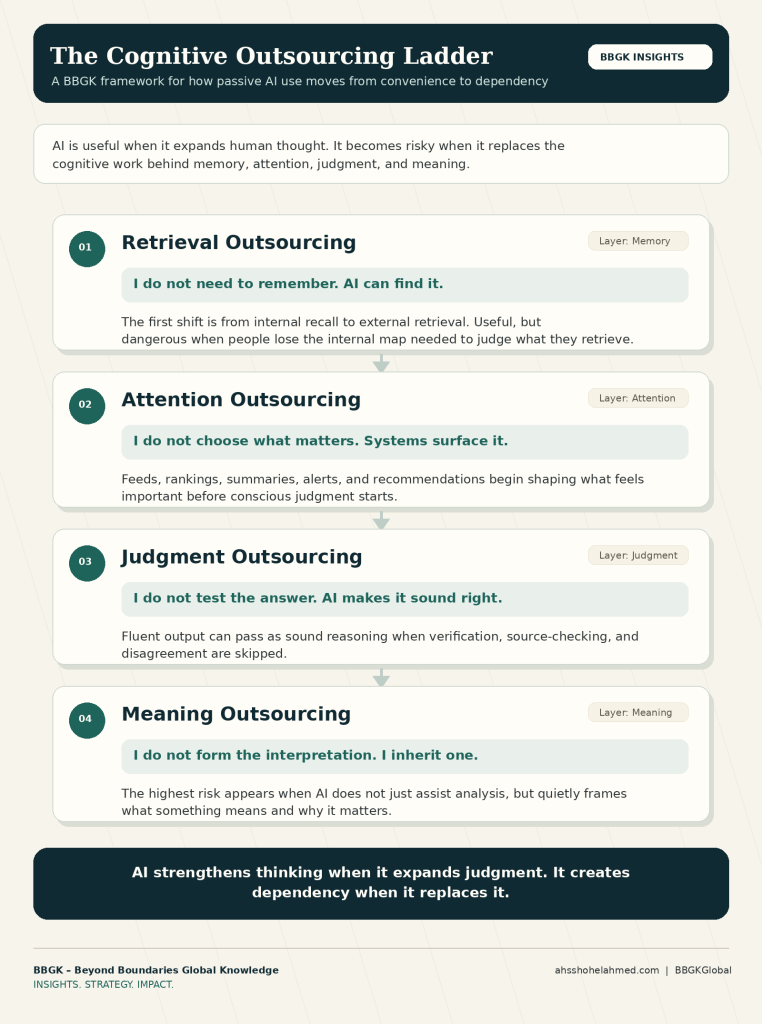
1. Retrieval Outsourcing
“I do not need to remember. AI can find it.”
This is the first stage. The user still thinks independently, but memory begins to move outside the person. Facts, references, definitions, examples, and explanations are retrieved on demand.
Used well, this is powerful. Used passively, it weakens the habit of internal retention.
The better question is not “Should we memorize everything?” The better question is: “What knowledge must remain internal for judgment to stay strong?”
2. Attention Outsourcing
“I do not choose what matters. Systems surface it.”
This is the second stage. The user no longer only asks for information. They increasingly rely on systems to decide what deserves attention.
This happens through feeds, rankings, alerts, recommendations, summaries, and AI-generated briefs.
The risk is not merely distraction. The risk is agenda-setting. If a system repeatedly decides what appears important, the user’s sense of importance can slowly adapt to the system.
3. Judgment Outsourcing
“I do not test the answer. AI makes it sound right.”
This is the third stage. Here, the user begins to accept AI output because it is fluent, organized, and confident.
This is one of the most serious AI-era risks.
- Fluency is not truth.
- Structure is not evidence.
- Confidence is not accuracy.
This is why BBGK’s AI Decision Boundary Framework is highly relevant: the central question is not whether AI can produce a useful answer, but where human judgment must remain decisive.
4. Meaning Outsourcing
“I do not form the interpretation. I inherit one.”
This is the fourth and deepest stage. At this point, the user does not merely use AI to retrieve, summarize, or improve thinking. The user begins to accept the system’s interpretation of what something means.
Meaning is not neutral. It shapes decisions, values, responsibility, and what people believe is worth doing.
For leaders, this is the highest-risk zone. If AI helps a team gather information, useful. If AI helps a team challenge assumptions, useful. If AI quietly becomes the source of interpretation, strategy, priority, and moral framing, the organization has moved from augmentation to dependency.
| That is not digital transformation. That is cognitive transfer. |
AI Can Weaken Questioning Before It Weakens Intelligence
The common public debate asks whether AI makes people smarter or less smart.
That is the wrong starting point.
The more immediate issue is whether AI weakens questioning.
Good thinking depends on questions:
- What is the evidence?
- What is missing?
- Who benefits from this framing?
- What assumptions are hidden?
- What would make this false?
- What are the second-order consequences?
- What alternative explanation fits the same facts?
When AI gives fast, polished answers, users may ask fewer of these questions. A 2025 paper on AI tools, cognitive offloading, and critical thinking argues that greater AI tool usage can be associated with reduced critical thinking through cognitive offloading. As with any single study, the finding should be treated as evidence to consider, not as final proof for every context.
The key word is practice.
Judgment is not only a trait. It is a practiced capacity. If people repeatedly skip comparison, testing, questioning, and synthesis, those habits may weaken over time.
The result is not immediate intellectual collapse. It is a gradual thinning of cognitive discipline.
The Leadership Risk: Faster Decisions, Thinner Judgment
For leaders, AI creates a difficult tradeoff.
It can improve speed, coverage, and operational efficiency. It can help teams draft faster, analyze more material, summarize complex issues, and generate options.
But faster decision-making is not the same as better decision-making.
A decision can become faster because the team has better information. Or it can become faster because the team has stopped doing enough independent thinking.
Those are different outcomes.
| AI can improve decision speed while quietly weakening decision depth. |
This matters in strategy, hiring, education, governance, marketing, research, content, finance, and public communication.
The organizational risks are practical:
- weak assumptions go unchallenged
- false summaries become accepted
- strategic nuance gets flattened
- ethical questions are treated as wording issues
- teams confuse output volume with progress
- leaders mistake polished language for strong thinking
This also connects to When AI Gives Bad Advice, because the danger is not only that AI can be wrong. The danger is that it can be wrong in a form that sounds polished enough to pass.
The danger is not using AI. The danger is using AI without cognitive governance.
For organizations, AI cognitive dependency can show up as faster reporting, faster drafting, and faster decision support, but with weaker internal challenge, thinner institutional memory, and less original judgment.
This is where trust and governance intersect. BBGK’s article AI Did Not Cause the Trust Crisis. Weak Governance Did. makes a related point: technology does not remove the need for disciplined oversight. It exposes the cost of weak oversight.
What Responsible AI Use Should Look Like
Responsible AI use should not be reduced to compliance, privacy, or technical safety alone. Those are necessary, but incomplete.
The deeper question is: Does AI use strengthen or weaken human thinking?
That gives us a better operating principle.
Use AI for expansion, not replacement
AI is strongest when it expands the field of thought.
- Ask it for alternative explanations.
- Ask it for objections.
- Ask it for missing variables.
- Ask it for weak points in your argument.
- Ask it for competing interpretations.
Do not use AI only to produce the final answer. Use it to widen the thinking process.
Keep humans responsible for judgment
AI can suggest, summarize, compare, simulate objections, and identify patterns. But responsibility remains human.
This is especially important in decisions involving people, risk, ethics, reputation, money, education, health, or public trust.
Require verification for important claims
Any serious claim should be checked. The more confident an AI answer sounds, the more disciplined the verification process should be.
AI systems can generate fluent errors. They can miss context. They can overgeneralize. They can cite weak sources. They can flatten uncertainty.
For BBGK, this is also an editorial principle. Do not publish claims only because they sound right. Publish claims because they have been checked, framed carefully, and connected to useful original insight. This is also why AI-era visibility work, discussed in Beyond Zero-Click: The Age of Invisible Inclusion, depends on clarity, validation, and durable trust rather than volume alone.
Design AI use around active thinking
The best AI workflows should make users think more clearly, not less.
A strong workflow might ask users to:
- state their own first answer before using AI
- ask AI for critique, not just completion
- compare AI output with source material
- identify assumptions and uncertainty
- write the final judgment themselves
This keeps AI in the role of thinking partner, not thinking substitute.
Teach younger users how to question AI
For students and younger users, the issue is especially important. UNESCO’s guidance for generative AI in education and research emphasizes human-centered implementation, policy development, and capacity-building rather than unmanaged adoption.
If AI becomes the default tool before core thinking habits are developed, users may become skilled at prompting without becoming skilled at reasoning.
That is not enough.
The educational goal should not be “use AI” or “avoid AI.” The goal should be: use AI while strengthening memory, attention, skepticism, synthesis, and independent judgment.
The goal is not to avoid AI. The goal is to prevent AI cognitive dependency by designing workflows that keep humans actively involved in questioning, verifying, interpreting, and deciding.
The Real Future Skill Is Cognitive Independence
The AI age will reward people who can think with machines without being absorbed by them.
That requires a new kind of cognitive independence.
Not independence from tools. Independence inside tool-rich environments.
The question is not whether we use AI. We will.
The question is what happens to human attention, memory, questioning, and judgment after repeated use.
| AI creates leverage when it strengthens human thinking. It creates dependency when it replaces the cognitive work behind understanding. |
That distinction may become one of the most important leadership skills of the next decade.
The strongest people and organizations will not be the ones producing the most AI-assisted output. They will be the ones that know when to slow down, question the answer, verify the source, preserve judgment, and keep meaning human.
Closing Thought
AI can help us think faster.
But the real test is whether it helps us think better.
If AI makes people quicker but less questioning, more productive but less reflective, more informed but less discerning, then the cost will not appear immediately.
It will show up later in weaker judgment, shallower understanding, and decisions that look efficient until they are tested by reality.
The future of AI should not be measured only by what machines can produce.
It should also be measured by what humans continue to practice.
The real test of AI adoption is not whether a team uses the tools. The real test of AI adoption is not whether a team uses the tools. It is whether those tools reduce cognitive dependency or quietly deepen it across the organization.
| Explore more BBGK analysis on AI, judgment, search, and human consequence, or read more about BBGK’s editorial mission. |
Evidence Base
This article is informed by a 2025 systematic review of AI, digital technology, social media, and cognitive functions, which discusses digital amnesia, cognitive offloading, attentional fragmentation, social cognition, and the need for ethical, multidisciplinary approaches to AI use. It also draws on wider research into internet use and cognition, cognitive offloading, memory externalization, and critical thinking in AI-mediated environments. See: IJRISS systematic review; Firth et al. on the online brain; Sparrow et al. on Google effects on memory; Risko and Gilbert on cognitive offloading; Gerlich on AI tools and critical thinking; and UNESCO guidance on generative AI in education and research.
