AI & Judgment | Evidence Review | November 2026
Key findings
- Across controlled studies from 2025-2026, more elaborate prompting rarely improved accuracy, and sometimes degraded it.
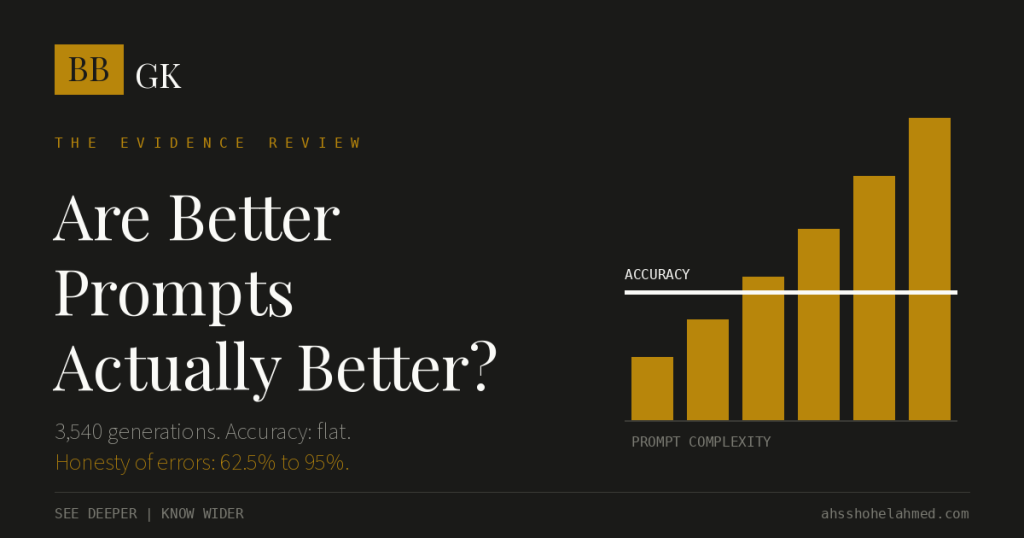
- In one 3,540-generation experiment, prompt design barely moved accuracy but swung the honesty of the model’s errors from 62.5% to 95%.
- The consequential skill is not writing longer prompts. It is identifying whether instructions, context, model or workflow is limiting the outcome, then testing the least costly fix.
The prompt that looked better but performed worse
In October 2026, the peer-reviewed journal Technologies published one of the most carefully structured tests of prompt effectiveness to date: a study of large language models interpreting mechanical engineering drawings, comparing six progressively more sophisticated prompt architectures across 3,540 generations. The elaborate prompts did not deliver more correct component identifications. Accuracy stayed within a few points across every architecture. What changed, dramatically, was the character of the errors: the share of mistakes the model admitted honestly ranged from 62.5% to 95% depending on prompt design, and the rate of confident fabrication spread roughly eightfold.
Read that again, because it inverts the usual promise of prompt engineering. The prompt did not decide whether the system succeeded. It decided how the system failed, and a wrong answer that reads as correct is the most expensive kind, a failure mode BBGK examined in When AI Gives Bad Advice. The study is narrow (twenty drawings, one technical domain), so it proves no universal law. But it names a question most prompt advice never asks: better at what, exactly?
What does “better prompting” actually mean?
Prompt effectiveness is whether the prompt measurably improves the outcome of a defined task: accuracy, reliability, verification effort, cost and risk.
The two are routinely confused. The evidence below shows they frequently come apart.
When people say a prompt made output “better”, they may mean any of five different things: the output looks more professional, it is more factually correct, it is more consistent across runs, it arrives faster, or it costs less to use and to check. These can move independently, and several of the strongest studies of 2025-2026 are, at bottom, demonstrations of one moving without the others.
The science of prompt sensitivity is more complicated than it looks
One research stream says models are alarmingly sensitive to wording. Kostiuk and Enevoldsen tested six instruction-tuned embedding models across 990 prompt-dataset configurations and found that favorable prompt selection could promote any model in the study to first place on a leaderboard. Sadrieh and Štefánik compared robustness-training strategies and still found best-to-worst prompt gaps of 40-57% of measured performance. In multimodal testing, the Promptception framework recorded accuracy deviations of up to 15% from minor phrasing changes across 61 prompt types and ten models.
A second stream says part of that sensitivity is a measurement illusion. Hua and colleagues showed at EMNLP 2025 that much reported sensitivity comes from rigid answer-matching that marks semantically correct responses wrong; under judge-based evaluation, validated against human annotators, variance dropped sharply and model rankings stabilized.
Both streams are right, about different things. Genuine performance sensitivity (the model returns a materially different result) and measurement sensitivity (the evaluator fails to recognize an acceptable answer) coexist. Any large prompt-sensitivity statistic deserves one question before it is quoted: how was the scoring done?
Which prompting techniques survive controlled testing?
Expert personas mostly do not, at least for factual accuracy. Wharton’s Generative AI Labs tested six models across 198 graduate-level GPQA questions and 300 MMLU-Pro questions, 25 trials per question per condition, and found expert personas did not reliably improve accuracy, while mismatched and low-knowledge personas sometimes degraded it. The finding is now contested: a 2026 rebuttal study argues personas do help under corrected benchmark conditions. Treat persona effects as unsettled for accuracy, and real for tone and audience fit.
Explicit chain-of-thought is conditional. Wharton’s chain-of-thought report found non-reasoning models gained up to about 13.5% on average, while dedicated reasoning models gained almost nothing (o3-mini +2.9%, o4-mini +3.1%, one model negative) and response times rose roughly 20-80%. A 2026 IEEE comparative study of code generation found the same shape: a real trade-off between reasoning benefit and resource cost, with chain-of-thought best reserved for tasks that genuinely need it.
Even high-quality examples can backfire. Wang and colleagues found that few-shot reasoning demonstrations consistently degraded reasoning-model accuracy, through two mechanisms: surface similarity lures the model into copying the exemplar’s steps, and problem-solving strategies fail to transfer. Restructured as extracted insights rather than raw demonstrations, the same material helped, lifting GPT-4.1 by 14 percentage points on a mathematics benchmark. An example that teaches a format is not an example that transfers a reasoning trajectory.
When more instructions become a liability
The overprompting pattern in the mechanical-drawing study has a plain mechanism: every added rule is another chance to introduce redundancy, contradiction or noise, and the model must spend attention reconciling instructions instead of solving the task. Vendor guidance has quietly converged on the same point. OpenAI’s prompting documentation advises that reasoning models work best with clear goals, constraints and output specifications rather than prescribed step-by-step procedures. And where output format is critical, escalating the wording (“always return valid JSON, never deviate”) is strictly weaker than enforcing a schema at the API layer, which OpenAI’s structured outputs documentation distinguishes from mere JSON mode. Instructions are a scarce resource. Spend them on requirements the system cannot infer, not on emphasis.
The shift from prompt wording to context quality
No prompt can supply information the system does not have. Google Research formalized this at ICLR 2025 with the concept of sufficient context: stratifying retrieval-augmented systems by whether the retrieved evidence could actually answer the question, the team found strong models excel when context is sufficient but tend to answer incorrectly rather than abstain when it is not. The failure was not wording. It was missing evidence, met with misplaced confidence.
More context is not automatically better context, though. The LongBench v2 benchmark, 503 questions over contexts up to two million words, held the best direct-answering model of its test generation to 50.1% accuracy, below the 53.7% human baseline. Models accept long inputs more readily than they integrate them. Anthropic’s engineering team drew the practical conclusion in its September 2025 article on effective context engineering, framing the discipline as the natural progression of prompt engineering: find the smallest set of high-signal tokens that maximizes the desired outcome. Google’s prompting guidance points the same way, pairing instructions and examples with grounding and tool use. The working question for every addition: does this improve the model’s ability to complete the task, or merely increase what it must process?
Why changing the model or workflow may be more effective
Two further levers routinely outperform prompt wording. The first is automated optimization: at ICLR 2026, the GEPA prompt evolution system beat a reinforcement-learning baseline by about six percentage points on average while using up to 35 times fewer optimization rollouts, and Microsoft’s PromptWizard showed feedback-driven refinement of instructions and examples across 45 tasks. Hand-tuning wording competes with machines that iterate faster.
The second is the surrounding workflow, including its security. Wharton’s prompt injection study, roughly 40,000 grading trials, found current frontier models largely resisted simple hidden injections while an older, smaller model inflated scores by nearly 20 points under the same attack. Which model you run, and what validation wraps it, is partly a security decision that no prompt phrasing substitutes for. This is delegation design, the territory of the AI Decision Boundary Framework: the closer a task sits to judgment the organization must own directly, the more the system around the model matters relative to the words sent into it.
Prompt sophistication vs. prompt effectiveness: the BBGK reading
Set the studies side by side and a pattern emerges that is sharper than “prompting is overrated”. Personas changed voice without changing correctness. Chain-of-thought changed visible effort, latency and cost more than answers. Elaborate architectures changed the confidence of errors while accuracy stood still. Across very different designs, interventions kept improving how output looks while leaving what it gets right untouched.
From this BBGK draws one inference, stated as an inference: prompt design often changes how an AI system fails more than whether it succeeds. If that holds, the real cost of a careless prompt lands not on the output but on the person verifying it, because confident fabrications are precisely the errors that evade review. A system that fails confidently also trains its users out of checking, the dynamic BBGK traced in AI cognitive dependency and in the research on cognitive offloading. The boundary of the claim: the honesty-of-error evidence comes from one twenty-drawing study, and the adjacent findings are directionally consistent but did not measure error honesty. This is an evidence-bounded hypothesis and a research agenda, not an established law.
How to test whether a prompt is actually better
The practical consequence is a measurement habit, not a technique. The BBGK Prompt Effectiveness Test, a working tool in the same family as the BBGK Evidence Meter, scores any prompt change on seven dimensions, each measured separately and never collapsed into a single number, because a composite hides unacceptable failures:
| Dimension | What to measure |
|---|---|
| Task success | Correct answers, completion rate, requirement satisfaction against a defined objective |
| Reliability | Variation across repeated trials, model snapshots and semantically equivalent prompt variants |
| Context relevance | Source sufficiency, evidence attribution, rate of unsupported claims |
| Instruction complexity | Input tokens, distinct constraints, contradictory or redundant requirements |
| Cost and latency | Spend, response time, tool calls and retries |
| Verification burden | Human correction minutes, material errors caught in review, reviewer agreement |
| Security and risk | Injection exposure, permissions, unsafe actions, sensitive-data handling |
And when output disappoints, diagnose before rewriting. The failure type points at the first intervention worth testing:
| Most prominent failure | First intervention to test |
|---|---|
| Incorrect or outdated facts | Improve source quality and retrieval before touching the prompt; the evidence may be missing |
| Wrong format, missed instructions | Enforce an output schema at the API layer; cut conflicting constraints |
| Weak reasoning on complex tasks | Try a stronger or reasoning-class model before adding step-by-step scaffolding |
| Inconsistent results | Simplify the prompt, test equivalent variants, pin the model version |
| Calculation or code failures | Add tools and deterministic validation, not instructions |
| Unsafe actions, untrusted inputs | Add permission boundaries and input isolation; warning text is not a control |
This selector is a diagnostic heuristic drawn from the studies above, not an experimentally validated algorithm. Its job is to stop the reflex of treating every AI failure as a wording problem.
Optimize outcomes, not instructions
The evidence supports a change of emphasis, not an obituary. Prompt engineering persists as one of four overlapping disciplines: what the instructions ask (prompt engineering), what the system can see (context engineering), how the work is orchestrated and checked (workflow engineering), and how performance is actually measured (evaluation engineering). The scarce skill is locating the binding constraint among them, which is a judgment task, and judgment is exactly what stays expensive while output gets cheap, the asymmetry BBGK has argued runs through the whole transition in AI acceleration and human adaptation.
Five actions follow directly from the research. Establish a zero-shot baseline before adopting any technique. Measure a technique’s effect on your task, not its reputation. Fix evidence before wording when facts are wrong. Enforce formats structurally, not rhetorically. And track verification minutes, because the prompt that saves you review time is the one that was actually better. A better prompt is not a longer prompt. It is one that measurably improves an outcome, and the measurement is the part most teams still skip.
Frequently asked questions
Does prompt engineering still matter in 2026?
Yes, but its role has changed. Controlled research and vendor documentation from OpenAI, Anthropic, Google and Microsoft point the same way: prompt wording is now one component of AI system performance alongside context quality, model capability and workflow controls. Anthropic explicitly describes context engineering as the natural progression of prompt engineering. The evidence supports a change in emphasis, not a disappearance.
Do longer, more detailed prompts produce better AI results?
Not reliably. A 2026 peer-reviewed study of 3,540 generations found that progressively more elaborate prompt architectures did not improve accuracy, while the honesty of the model’s errors varied from 62.5% to 95% across designs. Wharton studies found expert personas did not consistently improve factual accuracy, and explicit chain-of-thought added roughly 20-80% response time for marginal gains on reasoning models. Extra detail helps only when it supplies genuine requirements or evidence.
What is prompt effectiveness?
Prompt effectiveness is whether a prompt measurably improves the outcome of a defined task: accuracy, reliability, verification effort, cost and risk. It is distinct from prompt sophistication, which is how elaborate an instruction looks. The two are routinely confused, and controlled studies from 2025-2026 show they frequently come apart.
How do I test whether a prompt is actually better?
Measure it against a baseline. The BBGK Prompt Effectiveness Test scores a prompt change on seven dimensions separately: task success, reliability across repeated trials, context relevance, instruction complexity, cost and latency, human verification burden, and security risk. Never collapse the seven into a single score, and compare every candidate prompt against a simple zero-shot baseline before adopting it.
Research note: every study cited here was verified against its publisher record (arXiv, ACL Anthology, MDPI, ICLR, Wharton Generative AI Labs, Google Research) on 1-2 November 2026. Experimental results are reported as observations limited to what each design isolates; vendor guidance is treated as practitioner opinion; BBGK’s own reading is labeled as inference. One figure class to watch: benchmark scores describe the tested model generation, not necessarily current frontier systems.