Key takeaways
AI is unlikely to stop at a clean final point. The stronger expectation is uneven progress: fast in some areas, limited or unreliable in others.
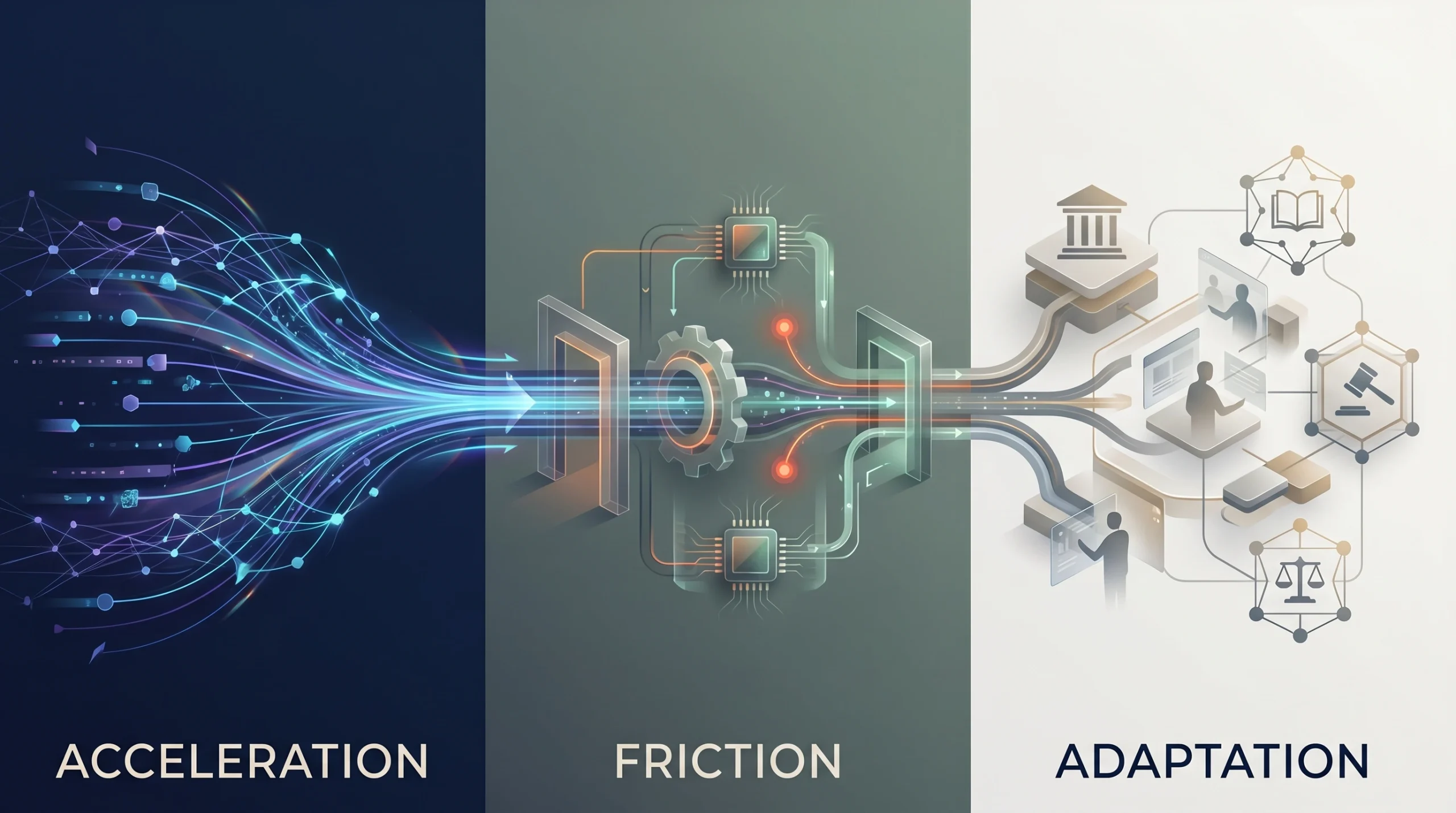
AI will hit friction. The biggest friction points are compute, energy, chips, data quality, reasoning limits, reliability, safety, governance, and trust.
The central risk is the human adaptation gap. AI systems are improving faster than people, schools, companies, governments, and professional norms can adapt.
Will AI ever stop improving?
AI is unlikely to stop at one clear boundary.
There may not be a final moment where society can say: “AI development is complete.” A more realistic view is that AI will keep improving unevenly. It may become extremely strong in some tasks, still weak in others, and risky when used without human judgment.
This unevenness already exists. Stanford’s 2026 AI Index describes a “jagged frontier” in AI capability: advanced systems can perform extremely well in some difficult tasks while still failing surprisingly simple ones. Gemini Deep Think achieved gold-medal-level performance at the International Mathematical Olympiad, while the top model read analog clocks correctly only 50.1% of the time.
|
The BBGK AI Adaptation Gap Framework
This framework names the central problem of the current AI period: the gap between how fast AI capability is advancing and how slowly human systems are catching up. That gap — not AI capability itself — is where the most significant risks and decisions live.
Why AI is accelerating
AI acceleration is not the result of one factor. It is several mutually reinforcing forces moving simultaneously — more compute, better chips, larger datasets, more efficient architectures, stronger reasoning methods, agentic workflows, enterprise adoption, and sustained global competition. The critical point is not that any one of these is new. It is that they are advancing in parallel, which is why the pace of adoption has surprised even people who expected AI to develop quickly. Stanford’s 2026 AI Index reports that generative AI reached 53% population adoption within three years — faster than the PC or the internet. The United States alone hosts 5,427 AI data centers, more than ten times any other country.
But fast adoption does not mean mature understanding. People are using AI before they fully understand its limits. Companies are deploying AI before they fully redesign accountability. Schools are managing AI use before they have clear policies. Stanford reports that over 80% of U.S. high school and college students use AI for school-related tasks, while only half of middle and high schools have AI policies in place, and only 6% of teachers say those policies are clear.
| This is not just a technology shift. It is a social operating-system shift. |
Where AI may stall
AI may not stop, but it can slow down, break down, or become harder to trust in specific areas.
Compute, energy, and chip constraints
AI progress depends on infrastructure: chips, data centers, electricity, cooling, capital, and supply chains. Stanford reports that a single company, TSMC, fabricates almost every leading AI chip, making the global AI hardware supply chain heavily dependent on one Taiwanese foundry. AI is not only a software story. It is also a hardware, energy, capital, and geopolitical story.
Data quality limits
AI models learn from data. But high-quality data is not infinite. As models consume more of the available public web, future improvement may depend less on simply adding more data and more on better data, synthetic data, specialised domain data, and improved training methods. This is why AI can improve dramatically in some measurable domains while remaining inconsistent in areas that require context, judgment, taste, ethics, or real-world accountability.
Reasoning generalisation
AI reasoning is improving, especially in domains with clear rules and verifiable answers. But the hard question is whether those improvements transfer reliably across messy human work. OECD’s 2026 paper on possible AI trajectories through 2030 explicitly frames AI progress as uncertain, with plausible scenarios ranging from stalled development to accelerated development. AI may improve quickly in coding, math, structured analysis, and tool use while remaining unstable in tasks requiring deep human context — precisely the territory explored in the BBGK Knowledge Distance framework.
Reliability and trust
NIST defines trustworthy AI through characteristics including validity, reliability, safety, security, resilience, accountability, transparency, explainability, interpretability, privacy, and fairness with harmful bias managed. NIST also states that human judgment should be used when deciding metrics and thresholds for AI trustworthiness.
AI systems do not become trustworthy simply because they produce fluent answers. Fluency is not reliability. Speed is not judgment. Confidence is not truth.
Long-horizon autonomy
METR defines task-completion time horizon as the task duration, measured by human expert completion time, at which an AI agent is predicted to succeed with a given level of reliability. The question is not only: Can AI answer? The better question is: Can AI carry responsibility across a longer chain of work? At present, that remains uneven.
Safety and governance
Stanford reports that documented AI incidents rose to 362, up from 233 in 2024, and that reporting on responsible AI benchmarks remains inconsistent among leading frontier model developers. Governance is now trying to catch up. The EU AI Act entered into force on August 1, 2024, and becomes fully applicable on August 2, 2026. Anthropic’s Responsible Scaling Policy was updated to version 3.0 in February 2026 and later to version 3.1, described as a living document that will continue changing as the company learns from real-world operation.
| AI governance is not settled. It is being rewritten while the technology is still accelerating. |
The human adaptation gap
The most important AI risk may not be that machines become powerful.
The deeper risk is that humans become unprepared.
AI systems can update in months. Human systems often update in years. Schools move slowly. Corporate training moves slowly. Laws move slowly. Professional standards move slowly. Public understanding moves slowly. But AI tools are already inside search engines, writing workflows, coding environments, customer support systems, design platforms, advertising tools, classrooms, and personal decision-making.
The IMF’s 2026 Staff Discussion Note says demand and supply of new skills, especially IT and AI skills, are reshaping labour markets, wages, and hiring. It reports that about one in ten job vacancies in advanced economies demands at least one new skill, while warning that these skills can boost wages and employment while deepening polarisation.
|
How professionals should adapt
The weak response is: “Learn AI tools.” That is not enough. Tools change. Interfaces change. Models change. The stronger response is to build durable AI-era capability — and to understand what that actually requires.
The starting point is problem framing, not tool fluency. Professionals who define problems with precision — specifying context, constraints, evidence standards, and success criteria — will extract consistently better outputs than those who prompt loosely. This is not a prompting skill. It is an analytical discipline.
The second requirement is verification. AI output should not be accepted because it sounds polished. Professionals need explicit verification workflows: check claims, compare sources, separate fact from inference, identify missing context, challenge assumptions. This connects directly to NIST’s emphasis on reliability, accountability, and human judgment in trustworthy AI.
The third and most durable requirement is judgment. AI reduces the value of generic output and increases the value of domain expertise, contextual understanding, stakeholder awareness, and final decision-making. This is the core argument of the BBGK AI Delegation Boundary Framework: AI can execute well within defined boundaries, but human judgment determines where those boundaries should be drawn — and when they should be overridden.
Finally, the productivity gain does not come from randomly applying AI to existing tasks. It comes from redesigning workflows around AI’s actual strengths: research intake, first-draft generation, evidence checking, synthesis, review, and documentation. The goal is not more output. It is better judgment about what output is worth producing.
|
AI as amplifier: the real question
The question “Is AI good or alarming?” is less useful than it sounds. AI is neither good nor alarming as a category. It is an amplifier.
It amplifies capability for people who know how to direct it. It amplifies confusion for people who treat it as an authority. It amplifies the speed of good work and the spread of weak work in equal measure. The outcome depends on the quality of the human systems surrounding it, not on the technology alone.
Stanford’s 2026 AI Index reports a striking gap between expert and public expectations: 73% of AI experts expect AI to positively affect how people do their jobs, compared with only 23% of the public. That gap is itself a form of the adaptation problem. Experts who work closely with AI systems have a more granular sense of both their capabilities and their limits. Most people do not have that granular sense yet — and the tools are already deployed at scale.
The amplifier framing also has a personal dimension. Research on AI’s cognitive effects on knowledge workers — including the BBGK analysis of cognitive offloading — suggests that the risk is not only institutional. The professionals who adapt well will not be those who use AI most, but those who maintain the judgment that determines how and when to use it.
|
The BBGK conclusion
AI may not stop. But it will hit friction.
It will hit friction in infrastructure, energy, chips, data, reliability, safety, governance, trust, and human adoption.
The bigger question is not whether AI gets better. It will.
The bigger question is whether humans can update their skills, institutions, workflows, education systems, laws, and judgment fast enough.
The future is not simply human versus AI. It is acceleration versus adaptation.
|
FAQ
Will AI ever stop improving?
AI is unlikely to stop at a clean final point. A more realistic expectation is uneven improvement, with fast progress in some domains and friction in others.
Where will AI development slow down?
AI development may slow down around compute, energy, chip supply, data quality, reasoning generalisation, reliability, safety, governance, and public trust.
What is the AI adaptation gap?
The AI adaptation gap is the distance between the speed of AI capability improvement and the slower pace at which humans, organisations, education systems, laws, and workflows adapt. It is the central concept of the BBGK AI Adaptation Gap Framework.
Is AI dangerous?
AI can be dangerous when deployed without reliability, accountability, transparency, privacy, safety, and human oversight. NIST’s AI Risk Management Framework emphasises these characteristics as part of trustworthy AI.
Is AI good for professionals?
AI can be good for professionals who use it to improve thinking, speed, research, analysis, and workflow quality. It is risky for professionals who use it as a substitute for judgment.
Will AI replace jobs?
AI is more likely to reshape tasks before it replaces whole jobs. The IMF notes that IT and AI skills are already reshaping labour markets, wages, and hiring, while also creating polarisation risks.
What skills matter most in the AI age?
The most durable skills are problem framing, verification, domain judgment, analytical thinking, communication, ethical reasoning, workflow design, and AI literacy.
What should ordinary people do?
Use AI to improve thinking, learning, and productivity, but do not treat it as an unquestionable authority. The practical rule is: use AI as a thinking partner, not a thinking replacement.
