Why American workers’ distrust of workplace AI reveals a deeper organizational bottleneck: human-system readiness.
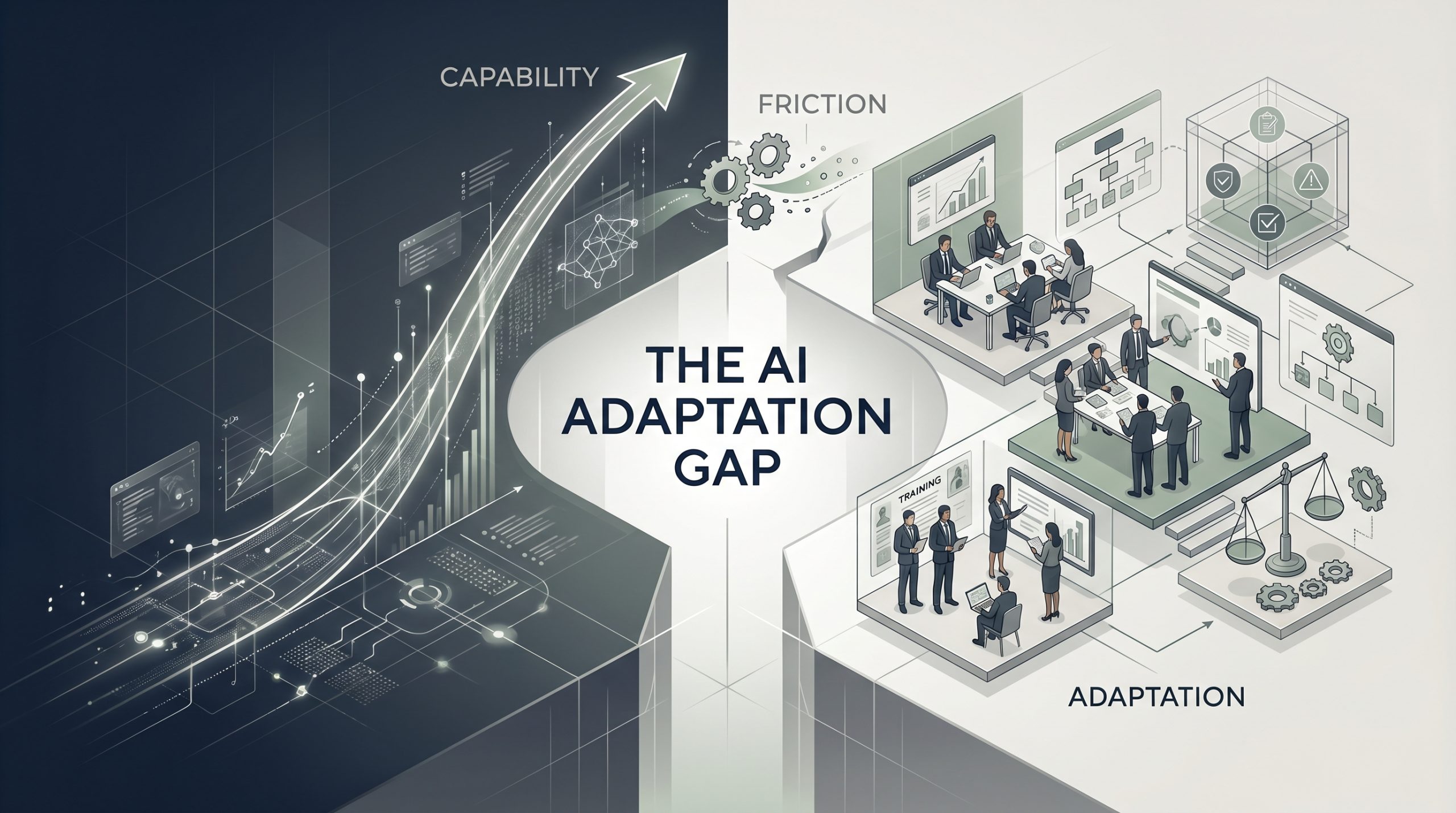
American workers are being described as some of the world’s biggest AI skeptics. ZDNET’s coverage captured the headline clearly. The underlying Salesforce Agentic Workplace Study provides the more important organizational signal.
Conducted with YouGov among more than 1,500 desk workers across 13 countries, the survey found that American workers were 43% more likely than the average global worker to describe themselves as AI skeptics. The survey ran from December 2025 to January 2026 and included workers with at least minimal familiarity with AI.
The headline invites a cultural explanation: perhaps American workers are simply more fearful of AI or more resistant to technological change.
But for leaders, there is a more useful diagnosis.
This is not only a skepticism problem.
It is an adaptation problem.
Among American respondents who reported unsuccessful AI tools or pilots, the leading problems were generic outputs, insufficient training, and low trust in the outputs.
That finding does not prove that every skeptical worker has experienced poor implementation. But it does suggest that skepticism can be a rational response to the quality of the AI system, training, workflow, and accountability structure surrounding the worker.
That is not resistance leaders should automatically dismiss.
That is a signal they should investigate.
The real issue is not AI capability
The AI conversation often starts with capability.
What can the model do? How fast is it improving? How many tasks can it automate? How many workflows can agents handle?
Those questions matter. But they are incomplete.
The harder question is this:
|
This is where the AI adaptation gap begins.
The AI adaptation gap is the distance between how quickly AI capabilities improve and how slowly human systems update—in skills, workflows, institutions, governance, and judgment.
AI capability can accelerate quickly. Organizations do not adapt at the same speed. People need training. Teams need new operating models. Managers need better expectations. Data systems need to become usable. Risk policies need to become practical. Workers need to know when to trust AI, when to challenge it, and when not to use it at all.
Without that adaptation layer, AI becomes another tool people are told to use but are not equipped to use well.
This gap is not abstract. It has a structure, and it shows up differently at each layer of the organization. The AI Leadership Readiness Stack addresses the same leadership failure from another angle: organizations scale AI capability before they build the human, operational, governance, and judgment systems required to control it.
Skepticism is a signal
Many leaders misread skepticism.
They interpret hesitation as fear, laziness, or resistance to change.
That is a weak diagnosis.
Based on what the Salesforce data suggests—and this is an inference, not a direct behavioral finding—skepticism may emerge after workers test AI inside a poorly designed system. They may see confident but shallow answers. They may spend extra time correcting outputs. They may be asked to use tools that do not understand their role, their data, their customer context, or their organization’s standards. They may receive access to AI without the training required to use it responsibly.
In that environment, skepticism is not the enemy of adoption.
Skepticism is diagnostic data.
It tells leaders where the system may be breaking. The same dynamic appears in the wider trust problem: when governance is weak and accountability is unclear, distrust follows logically—a pattern examined in AI Did Not Cause the Trust Crisis. Weak Governance Did.
Tool rollout is not transformation
Many organizations treat AI adoption as a software deployment.
Buy the tool. Announce the tool. Encourage usage. Track adoption. Expect productivity.
That is not transformation.
That is distribution.
Real AI transformation requires redesigning the conditions around work.
Workers need role-specific training, not generic AI enthusiasm. They need examples tied to their actual tasks. They need clear verification rules. They need access to trusted data. They need managers who understand the difference between speed and quality. They need workflows where AI is embedded into real work, not added as another disconnected layer.
Otherwise, AI creates hidden labor.
People spend time supplying missing context, checking outputs, rewriting drafts, correcting errors, comparing tools, and protecting quality after the model has finished. Glean’s 2026 Work AI Index illustrates the gap between individual usage and organizational value.
Although 87% of surveyed digital workers reported using AI and 75% said it made them more productive, only 13% said AI had significantly improved their organization’s performance. Workers also reported spending an average of 6.4 hours each week supplying context, supervising outputs, debugging errors, cleaning up work, and switching between tools.
The organization may see high adoption. Workers may feel faster. But significant value can still disappear through rework, fragmented tools, weak context, and unverified output.
That is why adoption numbers alone can mislead.
High usage does not automatically mean high value.
The trust problem is operational
Trust in AI is not built through slogans.
It is built through repeated experience.
When workers see that AI understands context, respects boundaries, improves output quality, and reduces unnecessary effort, trust increases. When they see generic answers, hallucinated details, unclear accountability, or extra correction work, trust collapses.
The issue is not whether AI is “good” or “bad.”
The issue is whether AI is usable inside a specific human system.
This is why the same technology can create enthusiasm in one organization and skepticism in another. The difference is not the model alone. As BBGK argues in When AI Gives Bad Advice, the most dangerous AI output is often not the obviously robotic answer. It is the persuasive answer that appears reliable before it has been verified.
The difference is adaptation design.
The BBGK view: the AI adaptation gap has three diagnostic layers
AI acceleration is real.
But acceleration alone does not produce progress.
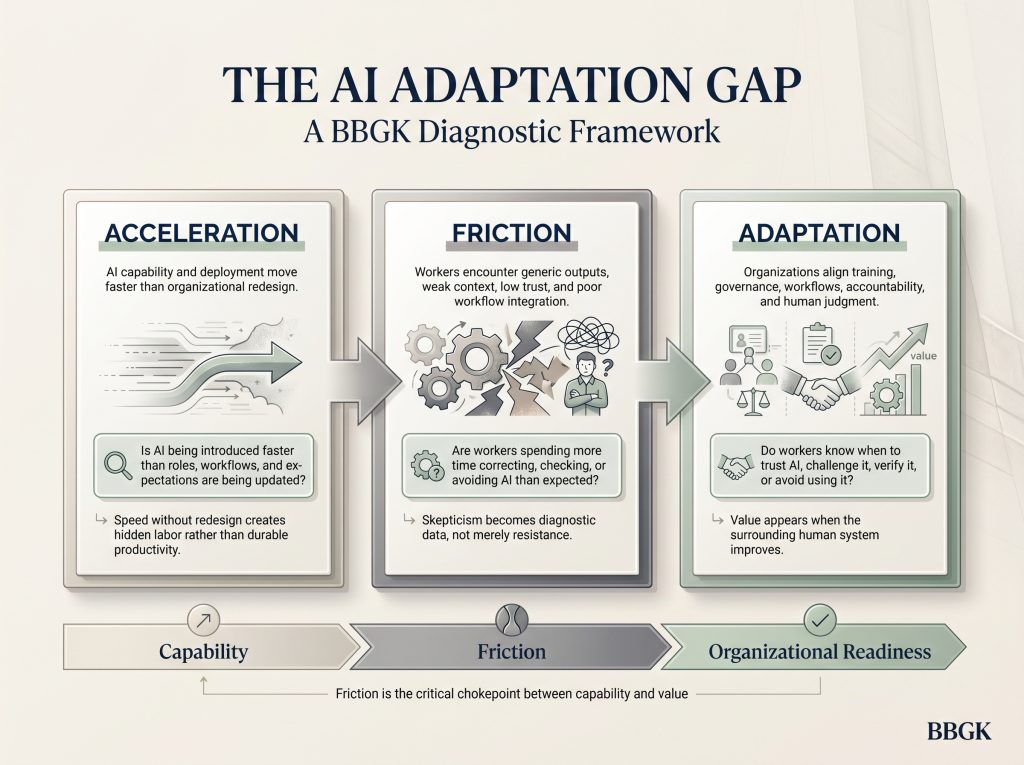
Between AI capability and human benefit, there is a friction layer. That friction includes fear, weak training, poor workflows, low trust, bad data, unclear governance, and judgment gaps. These are not side issues. They determine whether AI becomes useful or disruptive.
The AI adaptation gap is not a single problem. It has structure. Each layer produces a different failure mode—and each requires a different response.
The organizations that win will not simply be the ones that buy the most AI tools.
They will be the ones that reduce friction fastest.
Train people better. Redesign workflows more honestly. Make AI outputs easier to verify. Build trust through context, not hype. Preserve human judgment instead of pretending judgment can be fully automated.
This connects directly to the boundary question at the heart of AI governance: where should AI decide, and where must humans intervene? Organizations that cannot answer that question clearly have not closed the adaptation gap. They have simply added AI on top of it.
The same gap also has a cognitive dimension. When AI absorbs too many judgment tasks, workers may gradually lose the evaluative capacity required to detect its errors—a risk explored in When AI Helps Us Think Less.
The leadership lesson
American AI skepticism should not be dismissed.
It should be studied.
Workers may be telling leaders something important:
|
That is the real AI challenge now.
Not access. Not awareness. Not even usage.
Adaptation.
AI will keep accelerating. The question is whether human systems can update fast enough to use it wisely.
Sources and methodology
This analysis uses the Salesforce Agentic Workplace Study as the primary evidentiary anchor and ZDNET’s reporting as secondary coverage. The hidden-labor and organizational-value findings come from Glean’s Work AI Index 2026.
The AI Adaptation Gap is a BBGK interpretive framework applied to those findings. It is not a framework claimed by Salesforce, YouGov, ZDNET, or Glean. Survey findings are self-reported and should be treated as evidence of worker experience and perception—not as direct proof of organizational causality.
