Direct answerBill Gates’s August 2026 warning is more consequential than the headline “limits on AI” suggests. His central argument is that AI capability may advance faster than employment systems, education, taxation, safety institutions and governance can reorganize around it. Current evidence does not establish inevitable mass technological unemployment. It does show enough labor-market exposure, early-career pressure and policy lag to justify building transition systems before disruption becomes acute.
The headline says “limits.” Gates is arguing for a transition system.
CNN’s reporting emphasized Gates’s call for significant limits on artificial intelligence. That framing is not wrong. It is simply narrower than the argument in Gates’s original essay.
Gates says he would likely support a credible mechanism for slowing AI advances globally, but he does not believe the economic and geopolitical incentives make such a slowdown realistic. His highest-priority recommendation is therefore not a shutdown. It is the construction of a new domestic and international system for managing the transition.
That distinction matters. The underlying question is no longer only, How powerful should AI be allowed to become? It is also:
What happens when technological capability changes faster than the systems people depend on to absorb that change?
Gates argues that AI is different from earlier technological transitions because it can substitute for forms of human cognition, spread through devices people already own, and affect many sectors in parallel. He expects large employment effects and broader social disruption. Those are forecasts, not settled facts. But his institutional diagnosis is harder to dismiss: labor policy, education, taxation, security, healthcare, child protection and competition policy were not designed as one integrated response to a general-purpose technology that crosses all of them.
CNBC’s coverage sets out the same policy direction: a token tax that would make it more expensive to replace employees with AI tools or agents while funding support for those who lose work, alongside a category of work he calls Human Reserved.
What the labor evidence says now
The strongest version of the AI-jobs debate usually fails because it collapses several different forms of evidence into one claim. Observed payroll data, occupational exposure models, employer surveys and long-range forecasts do not answer the same question.
Employment among U.S. workers aged 22–25 in highly AI-exposed occupations sits about 19% below the path implied by similarly aged workers in less-exposed occupations. A year earlier the same gap was about 15%.
The same research found no evidence of widespread, economy-wide AI job displacement through June 2026.
One in four workers globally is in an occupation with some GenAI exposure. The ILO says transformation is more likely than complete redundancy for most jobs.
Employers expect structural labor churn equal to 22% of current formal jobs by 2030 across all major macrotrends studied, not AI alone.
| Evidence | What it supports | What it does not prove |
|---|---|---|
| Stanford Digital Economy Lab, August 2026 | Early-career employment pressure is widening in highly AI-exposed occupations, with adjustment appearing mainly through reduced hiring rather than increased separations. | It does not show economy-wide AI displacement or prove AI is the only cause of every employment difference. |
| ILO–NASK Global Index, 2025 | GenAI exposure is broad. Roughly one in four workers is in an occupation with some exposure. | Exposure is not equivalent to replacement. The ILO’s central conclusion is transformation rather than redundancy for most jobs. |
| OECD, Recent policy developments on AI in the labour market, July 2026 | Across the G7, the EU and selected Latin American economies, AI is already a live labor-policy issue spanning six areas: automation and productivity, skills and inclusiveness, privacy, non-discrimination, occupational safety, and transparency and accountability. | It does not establish that current policies are failing everywhere. It shows most countries handle AI through existing labor frameworks rather than stand-alone AI policy, with targeted measures most developed for skills and adoption and still emerging for privacy, transparency and accountability. |
| WEF Future of Jobs, 2025 | Employers expect substantial job creation and displacement simultaneously through 2030. | The 170 million created and 92 million displaced figures cover combined macrotrends. They must not be presented as AI-only job forecasts. |
That evidence is more nuanced than either “AI will destroy most jobs” or “technology always creates more jobs, so there is nothing to prepare for.” Both narratives claim more certainty than the current evidence supports.
The Stanford authors are careful about the limits of their own work, and repeating those limits strengthens the argument rather than weakening it. They describe their findings as early, descriptive indicators rather than causal estimates. The patterns attenuate when education is controlled for. Some divergent trends predate generative AI. The effect is more pronounced in the ADP payroll sample than in national survey benchmarks. What the data does show clearly is direction and persistence: the gap has widened steadily since it was first documented in August 2025, moving from roughly 15% then to roughly 19% now.
The International Labour Organization still sees task transformation as the most likely outcome for most occupations. The OECD’s Skills in the AI Age describes AI acting on labor markets through three channels at once — automating existing tasks, creating new ones, and raising productivity — with the net employment effect depending on which channel dominates. That is a different shape of argument from simple replacement.
At the same time, the Stanford Digital Economy Lab’s revised payroll analysis gives leaders a reason not to become complacent. It finds no broad displacement, but it does find a widening employment gap for 22–25-year-olds in highly AI-exposed occupations, concentrated where AI is used more to automate tasks than to complement workers.
The evidence needs three labels: observed, forecast and inference
Observed
Stanford sees no economy-wide AI displacement yet, while young workers in highly exposed occupations show a widening employment gap. ILO finds broad exposure but expects transformation to dominate replacement.
Forecast
Gates predicts much deeper and more permanent displacement as AI reliability and robotics improve. WEF reports employer expectations of major churn across multiple structural trends.
BBGK inference
Even without proof of mass unemployment, the combination of faster capability, early hiring pressure and fragmented policy creates a transition-planning problem now.
This separation is essential for credibility. A serious AI analysis should not convert a prominent technologist’s forecast into an established labor fact. Nor should it wait for irreversible disruption before considering institutional design.
The deeper problem is the BBGK AI Adaptation Gap
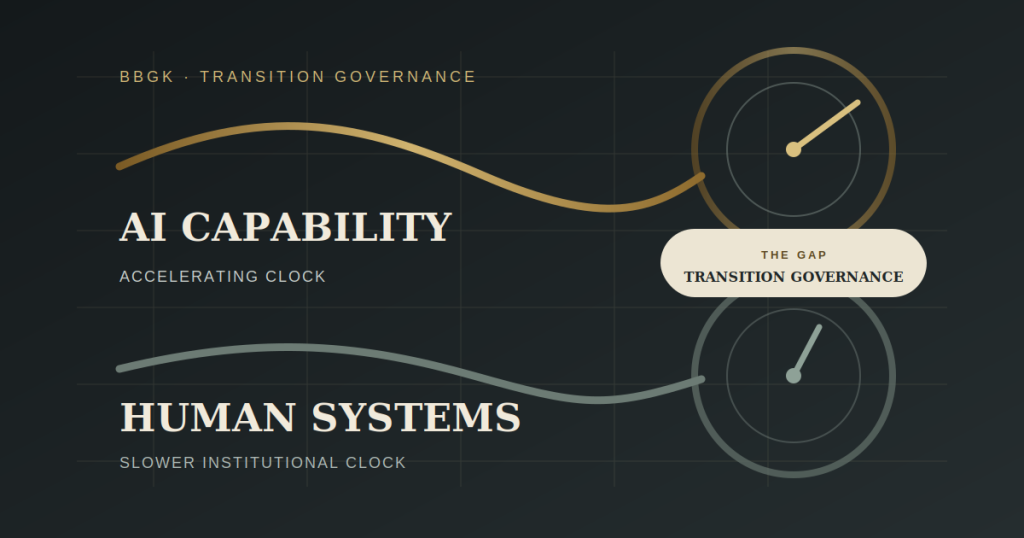
BBGK has previously defined the AI Adaptation Gap as the distance between how quickly AI capabilities improve and how slowly human systems update skills, workflows, institutions, governance and judgment.
The AI Adaptation Gap
The problem is not acceleration alone. The risk emerges when acceleration outruns the human systems needed to absorb, govern and direct it.
Gates’s essay is best understood as a macro-level version of that same structural problem. He argues that national security, employment, education, taxation, energy, elections, public health, finance and other domains overlap in ways existing bureaucracies are not designed to manage together.
Across the countries the OECD has studied, AI-related labor issues are still addressed mainly through existing labor-market frameworks rather than standalone AI labor policies, while targeted measures remain especially uneven in areas such as privacy, transparency and accountability. That does not mean existing institutions are incapable of adapting. It does mean institutional adaptation is still in progress while deployment continues.
A society can adopt AI quickly and still be dangerously unprepared for what adoption changes.
The entry-level warning may be bigger than the job-count debate
One of the most strategically important findings in the Stanford data is that the observed divergence appears to operate primarily through reduced hiring of younger workers, not unusually high firing.
That changes the shape of the problem.
An AI labor transition may not begin with millions of existing employees suddenly receiving termination notices. It may begin quietly: fewer junior analysts, fewer entry-level developers, fewer assistants, fewer routine research roles, and fewer opportunities through which inexperienced people traditionally become experienced.
This next point is a BBGK inference, not a finding from the Stanford paper: entry-level work often functions as part of an economy’s capability-development infrastructure. Junior tasks can look inefficient when examined one by one, yet they may be the practice environment through which future expertise, judgment and organizational memory are built.
That connects to BBGK’s work on Knowledge Distance. AI can often extend people into adjacent work, but fluent output does not automatically transfer the tacit standards required to judge deep domain execution. If organizations automate the learning ladder before redesigning how expertise is formed, they may reduce today’s labor cost while weakening tomorrow’s senior capability.
This is why the weak workforce response is simply “retrain people.” The stronger question is: What new pathway will produce expertise if the old pathway was built from work AI now performs?
“Human Reserved” asks a question efficiency cannot answer
Gates’s most distinctive proposal is a domain he calls Human Reserved: activities society may choose to keep meaningfully human even if machines become technically capable of doing them. His analogy is a nature reserve — land that could legally be built on, but is not, because what already stands there is worth more. His examples run from childcare and jury service to caregiving, delivering a terminal diagnosis, education and mental-health care. The reference point is personal: paid caregivers looked after his father through Alzheimer’s before his death in 2020, and Gates writes that “something in the care they gave my dad was irreplaceably human.”
He is explicit that the boundaries move. Education and mental-health care sit in a middle tier where he expects a human to remain in charge while using AI to extend their reach. The lines also vary by country: a nation with a shrinking workforce and too few young people to staff elder care may welcome caregiving robots where another would insist the work stays human. Gates concedes he cannot answer who decides.
The appeal is obvious. It also needs discipline.
“Humans should keep jobs because humans need jobs” is too weak a principle for durable policy. It can easily become protectionism, professional gatekeeping or a mechanism for suppressing technologies that genuinely expand access.
A stronger version asks where removing meaningful human participation would destroy value that efficiency metrics fail to capture. BBGK’s AI Decision Boundary Framework already supplies the underlying governance logic through its three decision zones. Read as a spectrum of human involvement rather than in numerical order, those zones map directly onto the Human Reserved question.
Zone 1
Where AI Should Decide
Routine, reversible, auditable tasks with clearly defined goals and measurable success, where error costs are contained and human presence adds little intrinsic value.
Zone 3
The Hybrid Zone
AI analyzes, drafts, triages or surfaces options, but a qualified person remains responsible for context, prioritization, restraint and override. AI may recommend. Humans remain accountable.
Zone 2
Where Humans Must Decide
Decisions or interactions where dignity, rights, safety, relationship, accountability or developmental value would be materially compromised by full delegation.
Human Reserved, in other words, is not a new category. It is a public-policy argument about which activities belong permanently in Zone 2 even after Zone 1 becomes technically feasible. Gates arrives at the same structure independently: his middle tier — a human in charge, using AI to extend their reach — is the Hybrid Zone described in different words. Where his framing adds something is in separating permanent protection, for work like caregiving, from temporary protection aimed at workers who cannot realistically retrain mid-career. That is a distinction the decision-boundary logic does not currently make.
A practical test for Human Reserved decisions
This is not a new BBGK framework. It is a practical application of the existing decision-boundary logic to Gates’s proposal.
| Criterion | Decision question | Why it matters |
|---|---|---|
| Dignity & relationship | Does the value of the interaction materially depend on empathy, trust, presence, care or social recognition? | Some human value exists in the relationship itself, not only in task completion. |
| Rights & safety | Could the outcome materially affect a person’s opportunity, livelihood, health, safety, liberty or meaningful consent? | Higher stakes require stronger human accountability and contestability. |
| Accountability | Must an identifiable person or institution answer for the decision in moral, professional or legal terms? | Human review is meaningless if no human truly owns the result. |
| Capability formation | Does doing the work build judgment or expertise needed for more senior responsibility later? | Automation can remove the training substrate that creates future experts. |
| Distribution & reversibility | Would automation create concentrated social harm, and can the decision be reversed if the transition proves damaging? | Fast, irreversible automation can externalize costs onto workers and communities. |
The goal is not to declare humans categorically superior. It is to identify contexts where technical capability is an insufficient reason for full delegation.
This also connects to BBGK’s research on AI cognitive dependency and the Performance–Capability Gap. Friction is not always waste. Some friction is how learning, memory, judgment, resilience and independent capability are formed. A system optimized only for removing friction can accidentally remove the practice that produces human competence.
Should AI be taxed when it replaces labor?
Gates also proposes rebalancing the tax treatment of labor and capital, including taxes on AI tokens and on robots. His logic is straightforward: employers pay payroll taxes when they hire a person but can often deduct a machine as a business expense, which builds a standing fiscal incentive to substitute capital for labor. A tax could slow that substitution and fund retraining and social protection at the moment demand for both rises.
The policy question is legitimate. The implementation is difficult.
| Proposal | Policy logic | Potential upside | Main risk | BBGK judgment |
|---|---|---|---|---|
| AI / robot tax | Reduce the fiscal bias toward substituting capital for labor and fund transition support. | Could slow abrupt displacement and help finance retraining or safety nets. | Defining “replacement” is difficult, and a token-level tax has an obvious leak: it pushes inference toward local and open-weight models that generate untaxed tokens. | Investigate, do not adopt simplistically. |
| Human Reserved | Preserve human roles where automation would destroy important social or relational value. | Creates explicit boundaries around dignity, care, accountability and capability formation. | Could become protectionism or block beneficial access if defined by incumbents. | Strong principle, needs rigorous criteria. |
| National AI coordination body | Coordinate policy across agencies whose mandates overlap through AI. | Reduces silo failures and clarifies cross-government responsibility. | Could become slow, duplicative or politicized. | High-value if authority and scope are clear. |
| International AI institution | Address cross-border risks, shared norms and dangerous capabilities. | Creates a venue for issues no country can solve alone. | Geopolitical competition may make enforcement weak or selective. | Necessary direction, uncertain feasibility. |
The stronger question is not whether Gates’s exact tax mechanism is optimal. It is whether tax systems designed around human labor remain appropriate if AI materially changes the relationship between labor, capital and productivity.
That is a fiscal-design problem. It deserves modeling, experimentation and distributional analysis rather than slogan-level advocacy.
New AI institutions may be necessary. Institutions alone will not solve adaptation.
Gates’s highest-priority recommendation is a domestic and international architecture for managing AI. He explicitly argues that no current institution was designed for a technology that spreads this quickly across national security, employment, education, taxation, energy, elections, public health, finance, transportation and other systems.
The diagnosis has support beyond Gates. OECD policy work shows governments adapting existing frameworks across multiple AI-related labor issues, while targeted policies remain more developed in some areas than others. The practical problem is coordination: different institutions see different slices of the same transition.
But institution-building carries its own risk. A global body can become slower than the technology it governs. A national coordination office can become another layer of bureaucracy without actual authority. International rules can be weak when economic and security incentives reward noncompliance.
So the design requirement is not simply “create an institution.” It is:
Build institutions with enough authority, evidence capacity and adaptation speed to govern a moving target.
This is consistent with BBGK’s broader work on adaptation failure. In AI Skepticism Is Not the Problem. Failed Adaptation Is., the argument is that worker distrust of workplace AI often signals weak implementation rather than resistance to change. The same pattern holds one level up. AI tends to expose accountability failures that already existed, and scaling it without clarifying ownership, review and non-delegable decisions simply scales the ambiguity.
The labor debate needs less certainty, not more
The World Economic Forum’s Future of Jobs Report 2025 illustrates why labor forecasting should be handled carefully. Based on employer expectations and ILO employment data, it estimated that combined macrotrends could create 170 million jobs and displace 92 million by 2030, producing net growth of 78 million. Those numbers are often repeated in AI discussions, but the report does not attribute all of that churn to AI.
ILO research points toward transformation. Stanford shows a meaningful early-career warning without broad displacement. WEF employers expect large creation and destruction simultaneously. Gates forecasts something substantially more disruptive as systems become more reliable and robotics advances.
These findings do not need to be forced into one conclusion. They belong to different evidence classes.
The defensible position is:
Mass technological unemployment is not established. Significant labor restructuring is credible enough that waiting for definitive proof before designing transition systems would be a poor risk strategy.
From AI governance to transition governance
For several years, most AI governance work has concentrated on model behavior: bias, reliability, safety, explainability, privacy, misuse and accountability. Those questions remain essential. They are also, increasingly, not the questions that determine social outcomes.
A model can be safe, explainable, unbiased and well-audited, and its deployment can still hollow out a profession’s training pipeline, shift tax burdens onto a shrinking labor base, or remove a form of human contact that mattered more than efficiency. Governing the model does not govern the transition. That is a second and largely unbuilt layer.
Transition Governance
The missing transition system has a name. Transition governance is the layer of policy and institutional design concerned not with how AI systems behave, but with how the systems around them are redesigned to absorb the change. AI governance asks whether the model is trustworthy. Transition governance asks whether the labor market, education system, career pathways, tax base and accountability structures can survive the model being trustworthy.
The AI Adaptation Gap names the diagnosis. Transition governance names the response. It has four unavoidable design questions.
Read that way, most of the current debate is arguing about one cell of a four-cell problem. The robot tax is a distributional-design proposal. Human Reserved is a delegation-boundary proposal. A national coordination office is an institutional-velocity proposal. Almost nobody is working on capability formation, which is where the Stanford entry-level data is pointing most directly.
Transition governance is the societal counterpart to work organizations must already do internally. The AI Leadership Readiness Stack sets out what senior leaders must control — accountability, risk, data discipline and judgment — before AI scales across an organization. Transition governance asks the same question at the level of a labor market, an education system or a tax base. The failure mode is identical at both scales: capability arrives before the structures that decide how it should be used.
This is not merely regulation of a technology.
It is the redesign of the systems around the technology.
Five questions leaders should be asking now
- What are we automating, and what capability are we accidentally removing?A task may look expendable while functioning as training, knowledge transfer, quality control, relationship building or judgment development.
- Where must a human remain genuinely accountable?Human oversight should not mean ceremonial approval after AI has effectively made the decision. Ownership requires context, authority to override and responsibility for the outcome.
- Are productivity gains becoming organizational capability or merely headcount reduction?Cost reduction can improve a short-term number while weakening institutional knowledge, resilience or future leadership capacity.
- What happens to our entry-level talent pipeline?If AI performs the work traditionally assigned to junior employees, the organization needs a new mechanism for producing experienced ones.
- Which interactions should remain meaningfully human?Not because humans are always more efficient, but because efficiency is not the only value organizations exist to preserve.
Organizations do not need to wait for governments to answer these questions. They can begin by mapping tasks, stakes, reversibility, training value, accountability and human-value requirements now.
The BBGK conclusion
Bill Gates may be right about some of his forecasts and wrong about others. AI may eliminate more jobs than current institutional estimates anticipate. Or augmentation, lower costs, new demand and new occupations may absorb substantially more disruption than pessimistic scenarios assume.
We do not know yet.
But the central problem does not require certainty about the final employment number. AI capability is advancing. Economic incentives favor deployment. Early labor-market signals deserve attention. And institutions built for slower technological transitions are being asked to govern something operating on a faster clock.
The challenge is not simply whether humans can build more capable AI. It is whether we can redesign the systems around it quickly enough to decide where capability should be used, where it should be constrained, where humans should remain essential, and how the gains and losses should be distributed.
The next phase of AI will not be determined only by what machines become capable of doing. It will also be determined by what humans become capable of reorganizing around them.
Frequently Asked Questions
Is Bill Gates calling for AI development to stop?
Not exactly. Gates says he would likely support a credible global mechanism for slowing AI advances, but he doubts such a mechanism is realistic because geopolitical and economic incentives favor continued development. His main proposal is to build institutions and policies that manage the transition.
Does current evidence show AI is already causing mass unemployment?
No. Stanford’s August 2026 payroll analysis found no evidence of widespread, economy-wide AI displacement through June 2026. It did find a widening employment gap for workers aged 22–25 in highly AI-exposed occupations, now about 19% and driven mainly by reduced hiring rather than increased separations.
What is transition governance?
Transition governance is the layer of policy and institutional design concerned not with how AI systems behave, but with how the systems around them are redesigned to absorb the change. AI governance asks whether a model is trustworthy. Transition governance asks whether labor markets, education systems, career pathways, tax bases and accountability structures can absorb that model being deployed at scale. Its four design questions are capability formation, delegation boundaries, distributional design and institutional velocity.
What does “Human Reserved” mean?
It is Bill Gates’s term for work or activities society may choose to keep meaningfully human even when AI or robots become technically capable of performing them. The strongest case is where dignity, relationship, rights, accountability, safety or human development would be materially weakened by full automation.
What is the BBGK AI Adaptation Gap?
The AI Adaptation Gap is the distance between how quickly AI capability advances and how slowly human systems update skills, workflows, institutions, governance and judgment. Acceleration and friction determine how wide the gap becomes; adaptation determines whether people and institutions close it.
Should governments tax AI and robots?
The fiscal question is legitimate, but the mechanism is unresolved. A tax could help fund transition support and reduce incentives for abrupt labor substitution, but defining replacement, protecting productive uses and avoiding competitiveness distortions would be difficult. It should be treated as a policy-design problem, not a simple yes-or-no proposition.
What should business leaders do now?
Map which tasks are being automated, identify non-delegable decisions, protect or redesign capability-building pathways, measure whether AI is augmenting or substituting work, and define where human accountability and human interaction remain essential.
Sources, evidence and methodology
This BBGK analysis separates three evidence classes: observed labor data, institutional or employer research, and forward-looking forecasts. Gates’s claims about future displacement are treated as forecasts rather than current labor facts.
- Primary source: Bill Gates, “The turbulent AI era is here. The choices we make now are critical,” August 26, 2026.
- Labor data: Stanford Digital Economy Lab, August 2026 update and the underlying revised working paper by Brynjolfsson, Chandar and Chen, using ADP payroll data through June 2026.
- Global occupational exposure: ILO–NASK, Generative AI and Jobs: A 2025 Update.
- Labor policy and skills: OECD, Recent policy developments on AI in the labour market (AI Papers No. 63, July 2026) and Skills in the AI Age (AI Papers No. 60, July 2026).
- Employer expectations: World Economic Forum, Future of Jobs Report 2025. Its 170M and 92M figures cover combined macrotrends, not AI alone.
- Contemporary reporting: CNN and CNBC.
Framework attribution: The AI Adaptation Gap, the AI Decision Boundary Framework and transition governance are BBGK frameworks and concepts. “Human Reserved” is Bill Gates’s term. The practical Human Reserved test in this article is BBGK analysis applying existing decision-boundary logic and should not be attributed to Gates, Stanford, ILO, OECD, WEF, CNN or Reuters.
Editorial note: This article is independent BBGK analysis. External sources are linked contextually so readers can inspect the underlying evidence and distinguish source claims from BBGK interpretation.
